


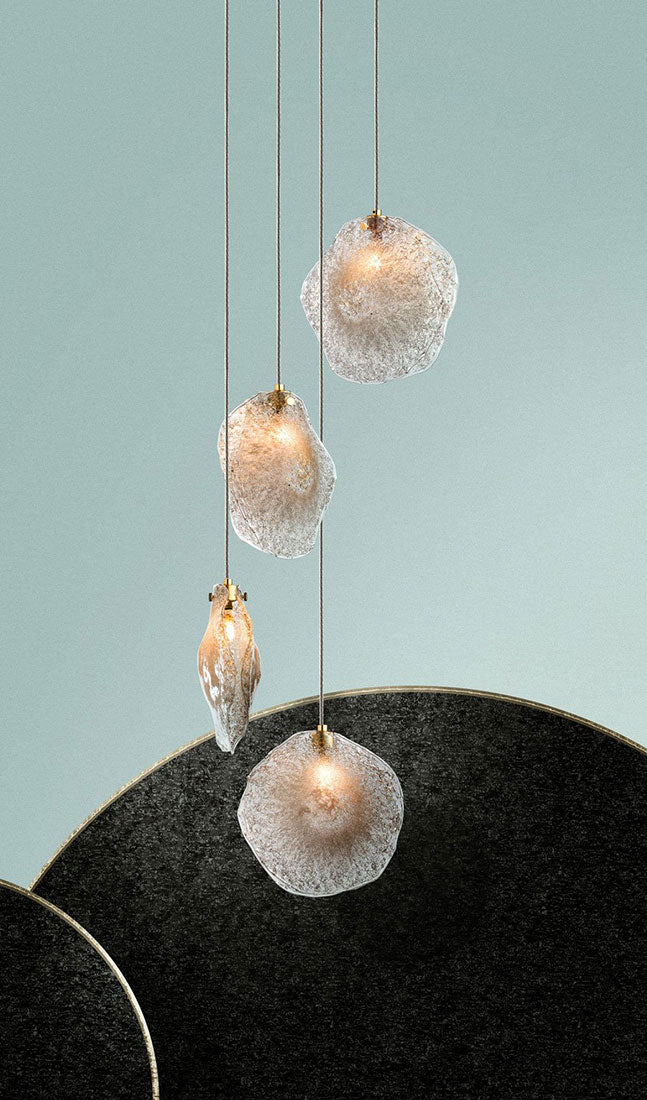


In the world of luxury lighting, the glass element of a fixture is often considered the star of the show. Whether it is a hand-blown drop pendant shimmering with internal air bubbles or a richly colored art glass sphere, our eyes are naturally drawn to the glowing, organic form.
Yet, any experienced interior designer or architect knows that the success of a bespoke lighting installation relies heavily on the supporting cast.
The metal hardware: the ceiling canopy, the mounting collars, the suspension rods, and the structural fittings: acts as the frame for the glass art. The metal finish you select establishes the design style, anchors the fixture within the room's broader architectural scheme, and dictates how the glass’s color and texture are perceived.
When configuring a custom lighting array, deciding on the base metal finish can be challenging. This guide breaks down how to choose between brass, bronze, or blackened metal hardware when pairing them with custom hand-blown glass.

The Visual Chemistry of Metal and Glass
Every metal finish possesses a unique color temperature and reflective quality. When placed directly adjacent to glass, the metal reflects light back into the glass body, subtly shifting the color profile and tone of the fixture.
For instance, pairing a clear glass globe with a polished brass socket collar injects a warm, golden-amber hue into the edges of the glass. Conversely, pairing that same clear globe with a blackened steel fitting isolates the glass, emphasizing its cool, icy clarity and crisp silhouette.
Understanding this visual relationship is key to creating a cohesive space. According to resources from the Smithsonian Institution, historic and modern design movements have long leveraged these specific pairings to evoke distinct atmospheric and cultural responses within a room.
Option 1: Warm and Luminous Brass
Brass is a classic, timeless choice that has enjoyed a massive resurgence in contemporary design. It contains a high copper-zinc ratio, giving it a bright, golden undertone that instantly adds warmth to a space.
Common Finishes of Brass
-
Polished Brass: Highly reflective and brilliant. It acts as a mirror, catching ambient light and reflecting it outward.
-
Brushed/Satin Brass: Features a soft, directional texture that scatters reflection, giving the metal a subtle, matte glow.
-
Antique Brass: Chemically darkened and rubbed to mimic natural aging, offering a rich, historic depth with warm undertones.
Best Glass Pairings for Brass
Brass pairs exceptionally well with glass that shares warm, earthy, or rich color tones.
-
Amber and Gold Glass: Accentuates the deep, fiery tones of warm glass, creating a seamless, monochromatic look.
-
Seeded Glass: The sparkling bubbles in seeded glass spheres catch the golden reflections of a brass socket collar, amplifying the light's warmth.
-
Frosted Opal Glass: The clean, stark white of frosted glass stands out beautifully against satin brass, offering a classic mid-century modern aesthetic.
Option 2: Rich and Grounded Bronze
Bronze is a historic alloy composed primarily of copper and tin. It possesses a deeper, redder, and more complex undertone than brass, bringing an immediate sense of weight, luxury, and organic permanence to a fixture's hardware.
Common Finishes of Bronze
-
Oil-Rubbed Bronze: A chemically darkened finish that mimics naturally aged bronze. It features a nearly black-brown surface with warm, reddish-copper highlights peaking through along the edges.
-
Satin Bronze: A smooth, medium-brown finish with warm, golden-coppery undertones that does not show fingerprints or smudges.
Best Glass Pairings for Bronze
Because bronze is visually heavy and complex, it excels when paired with glass that features rich, saturated colors or dramatic textures.
-
Cobalt Blue Glass: The deep, royal blue of cobalt glass creates a striking, regal contrast against the dark, warm undertones of oil-rubbed bronze.
-
Drizzled or Textured Glass: The layered, fluid patterns of drizzled glass designs mimic natural stone or water. Bronze hardware grounds these organic profiles, making the light fixture feel like a natural extension of the architecture.
-
Smoke and Charcoal Glass: Dark, moody glass paired with dark bronze creates a sophisticated, low-contrast design that fits perfectly in library spaces, dens, or intimate dining rooms.
Option 3: Modern and Architectural Blackened Metal
Blackened metal, whether achieved through chemical patination, matte black powder-coating, or blackened steel processing, is the ultimate modern neutral. It absorbs light rather than reflecting it, creating a sharp, high-contrast silhouette that outlines the glass art.
Common Finishes of Blackened Metal
-
Matte Black: A completely flat, non-reflective finish that offers a clean, graphic, and architectural look.
-
Blackened Steel/Iron: A living finish with subtle variations in charcoal gray and deep black, showcasing raw, industrial textures.
Best Glass Pairings for Blackened Metal
Blackened metal functions like a picture frame, drawing full attention to the glass itself. It pairs beautifully with almost any glass style, but it works exceptionally well with:
-
Clear and Optically Pure Glass: Emphasizes the transparent quality of the glass, creating a light, floating appearance.
-
Vibrant Jewel Tones: Bright rubies, emerald greens, and rich ambers pop dramatically against a solid black canopy or cable system.
-
Geometric Glass Shapes: Highlights the hard lines of modern geometric pendants, emphasizing their clean architectural forms.
Quick Reference: Hardware Finish and Glass Pairing Guide
To help you plan your hardware specifications, review this compatibility matrix:
|
Hardware Finish |
Tone / Temperature |
Design Aesthetic |
Ideal Glass Color Pairings |
Ideal Glass Texture Pairings |
|
Brushed / Satin Brass |
Warm, golden, bright |
Mid-Century Modern, Transitional, Glam |
Amber, Gold, Pink, Frosted White |
Seeded, Smooth, Ribbed |
|
Oil-Rubbed Bronze |
Deep, dark, copper undertones |
Traditional, Rustic, Transitional |
Cobalt Blue, Emerald Green, Smoke |
Drizzled, Ruffled, Heavy Textured |
|
Matte Black |
Neutral, cool, absorbing |
Modern, Minimalist, Industrial |
Clear, Charcoal, Vibrant Jewel Tones |
Geometric, Smooth, Frosted |
|
Polished Chrome / Nickel |
Cool, silver, highly reflective |
Ultra-Modern, Contemporary |
Icy Blue, Clear, Silver Leaf |
Smooth, Optically Clear, Faceted |

How to Coordinate Finishes Across a Room
A common question interior designers face is: Does the hardware on my custom light fixture have to match the faucets and cabinet pulls in the room?
The short answer is no. In modern, high-end interior design, matching every single metal element can make a home feel sterile and devoid of character. Instead, designers rely on the art of mixing metals.
To mix metals like a professional, follow this structured spatial workflow:
1. Identify your dominant metal finish: 60% of the room.
This is typically the metal used for large-scale items, such as your kitchen cabinet hardware or primary plumbing fixtures.
2. Select your secondary metal finish: 30% of the room.
Choose a contrasting metal to introduce depth. For example, if your dominant metal is cool polished nickel, select a warm brushed brass as your secondary accent.
3. Establish the accent metal: 10% of the room.
Use your custom lighting canopy and hardware as the bold accent metal to draw the eye upward and anchor the room's high-ceiling planes.
4. Maintain consistent color temperatures: A cohesive plan.
Ensure that your chosen metals share complementary temperatures. For instance, pair warm brass with warm bronze, or cool chrome with a neutral matte black.
Aesthetic Note: Hand-blown glass is an organic medium. Because each piece is individual and unique, selecting a hardware finish that matches the organic, slightly varied nature of the glass, such as a brushed or patinated metal rather than a highly uniform, machine-polished finish, will create a much more harmonious and artistic final fixture.