


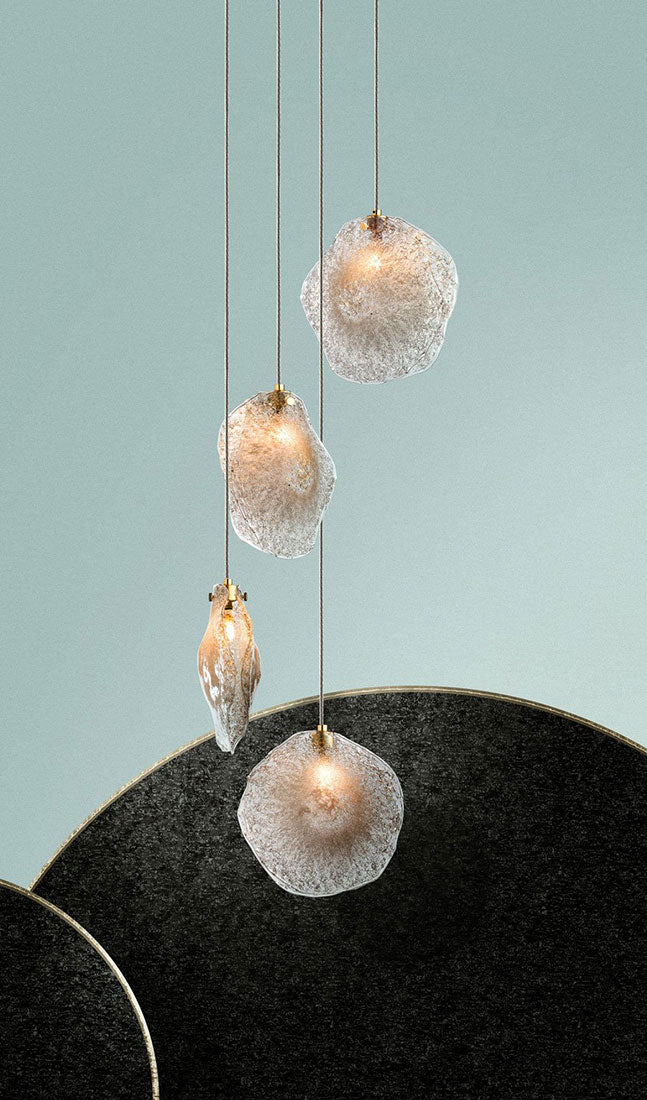


The kitchen island is the undeniable heart of the modern home. It is where morning espresso is sipped, meals are prepped, homework is supervised, and guests linger during dinner parties. Because this single surface transitions constantly between highly detailed task work and intimate, ambient socializing, its lighting must be flawless.
While selecting gorgeous hand-blown art glass is the most exciting part of the design process, the success of your installation depends entirely on technical precision. Hanging fixtures too low interrupts your line of sight; spacing them too far apart creates dark voids on your quartz or marble countertops.
This comprehensive guide details the mathematical rules, spacing formulas, and spatial principles needed to hang pendant lights over a kitchen island to balance peak functionality with high-end interior aesthetics.

The Golden Rules of Pendant Height
How high should pendant lights hang above a kitchen island? The industry standard is to position the bottom rim of the fixture 30 to 36 inches above the surface of the countertop.
This height is calculated based on an average countertop height of 36 inches, placing the bottom of your pendants roughly 66 to 72 inches (5.5 to 6 feet) above the finished floor. This range protects natural sightlines across the room while providing excellent task lighting.
However, standard rules require adjusting for your specific home environment.
Adjusting for Ceiling Height
The standard 30 to 36 inch rule assumes an 8 foot ceiling. For taller spaces, you should adjust the mounting height upward to prevent the fixtures from looking unanchored in the volume of the room.
-
9 Foot Ceilings: Hang pendants 32 to 36 inches above the countertop.
-
10 Foot (or taller) Ceilings: Hang pendants 36 to 40 inches above the countertop.
-
The Scale Rule: For every foot of ceiling height above 8 feet, add 1 to 2 inches to the hanging height.
Considering Personal Sightlines
If the primary cook in your home is taller than 6 feet, hanging a low, wide pendant at 30 inches will block their view of the living or dining area. Before finalizing your installation, have someone hold the light fixture at different heights while you stand at the island to test your sightline.
Fixture Material and Visual Mass
The physical density of your light fixture affects how high it should be hung.
-
Heavy, opaque fixtures (like solid metals, ceramics, or dark-colored glass) create high visual weight. If hung too low, they can feel imposing. Give these materials breathing room by hanging them closer to the 36-inch limit.
-
Light, translucent fixtures (like clear glass globes or delicate, textured glass) have low visual weight. They preserve sightlines and can easily sit closer to the 30-inch mark without overwhelming the kitchen.
Perfect Spacing Formulas
To avoid pockets of darkness or a cluttered visual layout, you must calculate the precise distance between each pendant and their distance from the outer edges of the kitchen island.
The Edge-to-Edge Boundary
Pendant lights should never hang directly over the edge of your island. To maintain visual balance and keep light focused on the active workspace, always leave 6 to 12 inches of clearance from the outermost edge of the island countertop to the widest part of your nearest light fixture.
Spacing Between Pendants
Your spacing should be equal to or greater than the diameter of the fixtures. For example, if you are hanging pendants that are 10 inches wide, you should leave at least 10 inches (and ideally up to 18 to 24 inches) of space between them to maintain balance and prevent the ceiling from looking crowded.
To calculate the exact placement of your electrical junction boxes, use the following step-by-step formula:
1. Measure the total island length: In inches.
Measure the absolute length of your countertop from end to end. Let us assume a standard island length of 96 inches.
2. Determine your desired number of fixtures: Typically 2 or 3.
For this example, we will calculate the spacing for 3 pendants.
3. Divide the island into equal segments: One segment per light.
To find the center point of each segment, divide the total length of the island by the number of pendants.
4. Mark the center point of each segment: These are your hanging points.
Your three pendant lights will hang precisely in the middle of these three equal 32-inch segments:
-
Pendant 1 (Left): Hangs at the center of the first segment (16 inches from the left edge).
-
Pendant 2 (Center): Hangs at the absolute center of the island (48 inches from either edge).
-
Pendant 3 (Right): Hangs at the center of the third segment (80 inches from the left edge, which is 16 inches from the right edge).

How Many Pendants Do You Need?
The number of fixtures you choose depends entirely on the length of your island and the diameter of the light fixtures themselves.
Historically, interior design relies on the "Rule of Three." Odd numbers create visual balance and guide the eye smoothly across a space. However, very small or exceptionally long islands often break this rule to prioritize scale and proportion.
|
Island Length |
Recommended Number of Pendants |
Ideal Fixture Diameter |
|
Under 5 Feet (60 inches) |
1 large linear fixture or 2 small pendants |
8 to 10 inches |
|
5 to 7 Feet (60 to 84 inches) |
2 medium pendants |
11 to 14 inches |
|
8 to 10 Feet (96 to 120 inches) |
3 medium to large pendants |
12 to 18 inches |
|
Over 10 Feet (120+ inches) |
3 to 4 large pendants or a custom multi-pendant canopy |
18+ inches |
How to Size the Diameter of Your Pendants
To quickly check if a fixture's scale matches your island's size, you can use this simple equation:
-
Measure the width of your kitchen island in inches.
-
Subtract 12 from that number.
-
The remaining value is the maximum recommended diameter for a single pendant light.
For instance, if your island is 36 inches wide, your pendants should not exceed 24 inches in diameter to prevent the lighting from physically dominating the narrow island.
Choosing Your Lighting Layer: Art Glass vs. Flat Industrial Fixtures
While the structural rules of lighting are universal, the material of your pendant dictates the quality of light projected onto your work surfaces.
Standard mass-manufactured, factory-line metal dome pendants act like spotlights, throwing a harsh, directional cone of light straight downward while leaving the ceiling and upper walls in shadow. In contrast, handcrafted glass pendants function as sculptural art that diffuses light throughout the room.
Choosing textured art glass, such as drizzled, dimpled, or ruffled styles, breaks up and scatters light rays in multiple directions. This minimizes glare on polished quartz countertops, softens overlapping shadows, and creates a warmer, more inviting kitchen environment.
Architectural and Electrical Planning Tips
Before your contractor runs wire through your ceiling joists, review these final layout details to ensure your kitchen island lighting performs beautifully.
1. Account for Architectural Obstacles
Verify that your planned pendant locations do not conflict with:
-
HVAC vents or heating registers.
-
Structural support columns or ceiling beams.
-
Cabinet doors: Ensure that wall cabinets or pantry doors can swing fully open without hitting your hanging fixtures.
-
Range hoods: If your cooktop is built into the island, your pendants must sit far enough away from the hood to prevent grease buildup and avoid blocking the hood's extraction path.
2. Implement Dual-Switch Zoning
If your island features both a prep sink and a casual dining bar, consider wiring your pendants on a separate circuit from the rest of your kitchen's recessed lighting. Installing high-quality LED dimmer switches allows you to shift from bright, clear task lighting during meal prep to a low, warm glow for evening entertaining.
3. Choose the Right Color Temperature
The color temperature of your light bulbs heavily influences the look and feel of your kitchen materials. The Illuminating Engineering Society (IES) recommends using LED bulbs with a color temperature of 2700K to 3000K for residential kitchens.
-
2700K (Warm White): Delivers a cozy, traditional glow that highlights warm wood cabinetry and natural stone grains.
-
3000K (Soft White): Provides a clean, crisp light that enhances modern, white, or minimalist kitchens without feeling sterile.
Always select bulbs with a High Color Rendering Index (CRI of 90 or higher) to ensure that food, ingredients, and finishes appear in their most natural, appetizing colors.
Design Tip: If you are working with sloped, vaulted, or cathedral ceilings, look for customizable pendant fixtures mounted on flexible cords or adjustable rods. These can be leveled individually at the canopy to ensure each glass element hangs perfectly level above your flat island surface.