


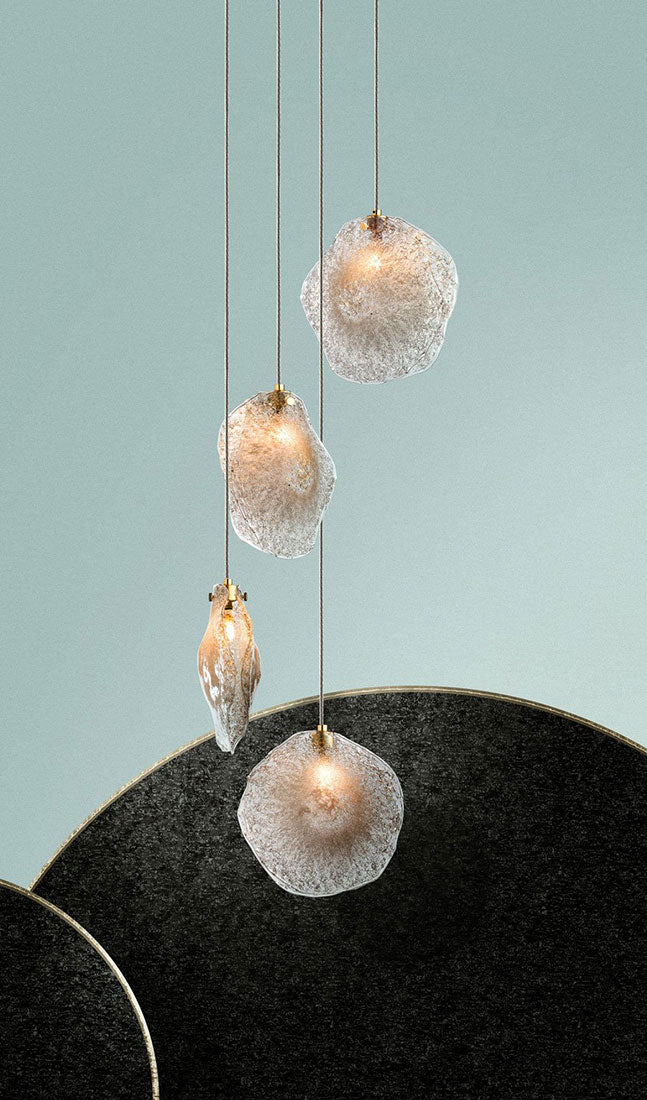


Blowing custom glass lighting fixtures is both a technical craft and a design process. Molten glass must be shaped while it is hot and responsive, using controlled movement, tools, gravity, and practiced technique. The finished glass then becomes part of a larger lighting composition where scale, texture, color, suspension, and architectural placement all matter.
For Shakúff, this relationship between glass and light is central to the studio's work. Its fixtures are handcrafted and customizable, with natural variations in size, color, shape, and texture forming part of the character of the finished glass.
Hand-Blown Glass Begins With the Material
Glassblowing requires an understanding of how glass behaves at different temperatures. When sufficiently heated, glass becomes fluid enough to gather, rotate, stretch, inflate, and shape. As it cools, it becomes progressively more resistant to movement.
This means the artisan is continuously responding to the material rather than simply following a fixed mechanical process. Timing, rotation, gravity, and tool placement all affect the developing form.
That relationship helps explain why handmade glass does not have the absolute uniformity associated with machine-produced materials. Shakúff specifically notes that variations such as bubbles, fissures, crackling, crazing, shape, color, and texture are inherent characteristics of its handmade glass.
In custom lighting, these distinctions become especially visible because illumination interacts directly with the material.
From Glass Form to Lighting Design
Creating a blown-glass object is only one part of producing a custom fixture.
Before fabrication, designers need to consider how the glass will function within a room. Fixture dimensions, ceiling height, canopy configuration, suspension length, number of glass elements, finish, and the relationship between the fixture and surrounding architecture all influence the final composition.
Shakúff's custom lighting process begins with discovery and design development. Project requirements, visual preferences, finishes, structural details, and electrical conditions are considered before the fixture moves into fabrication. A 3D rendering is also prepared during the design and appraisal stage so the proposed composition can be reviewed before production.
This is particularly important for custom chandeliers where multiple pieces of glass need to read as a single architectural element.
Texture Gives Blown Glass Its Character
One of the most expressive qualities of blown-glass lighting is texture.
Surface treatment changes not only how the glass looks, but also how light travels through and around it. Smooth glass produces a different visual effect from perforated, dimpled, ridged, or heavily textured glass.
Shakúff's Nimbus 3 demonstrates a relatively restrained approach. Each Nimbus pendant is formed as a smooth blown-glass orb with a subtle dimpled surface. The design can be customized through glass size and color, and larger Nimbus compositions can use multiple pendants to create a broader chandelier arrangement.
The result is a fixture where the simplicity of the form allows small surface variations and the quality of the glass itself to become visually important.
Glassblowing Can Create More Complex Surfaces
Other Shakúff collections explore significantly more pronounced glass textures.
The Kadur Drizzle 3 uses an inner orb filled with drizzled glass fibers, which is then encased inside a clear outer glass sphere. This creates depth within the pendant rather than relying exclusively on texture applied to the exterior surface.
That layered construction changes the way the fixture is perceived. Light interacts with both the outer sphere and the network of glass fibers contained inside it, giving the piece more visual complexity while maintaining a recognizable orb-like silhouette.
The ability to control the internal and external character of glass is part of what makes the material so versatile for decorative lighting.
Handcrafted Texture Can Become the Main Design Feature
In some fixtures, the glassmaking technique itself becomes the defining visual language.
Shakúff's Mod 3 features glass with a delicately perforated, open mesh-like texture. The holes create a very different relationship between transparency, shadow, and illumination than a smooth glass surface.
By comparison, the Cocoon 3 uses drizzled ropes of glass that fully envelop the surface of its egg-shaped pendants, creating a rich and heavily textured exterior.
These fixtures demonstrate why glass texture should be considered as part of the lighting design rather than as decoration added afterward. Texture influences visual weight, diffusion, reflections, shadows, and how the fixture changes between daylight and nighttime illumination.
Repetition Turns Individual Glass Pieces Into Sculpture
A single blown-glass pendant emphasizes the form of one handmade object. A chandelier introduces another layer of design through repetition.
Multiple glass elements can be arranged tightly together, spread horizontally, suspended at different heights, or distributed vertically through a tall space. The individual glass pieces remain important, but spacing and composition determine how the installation works architecturally.
The Globe 3 uses smooth blown-glass orbs with a subtle diagonal ridged surface and a puckered open bottom. Like several Shakúff collections, the Globe design can expand from individual pendants into multi-pendant arrangements.
This modular approach allows designers to respond to a room rather than forcing the room to accommodate a predetermined chandelier shape.
Customization Connects Craft With Architecture
The real value of custom glass lighting lies in the ability to coordinate craftsmanship with the proportions and materials of a specific interior.
Shakúff states that its collections can be customized through different colors, finishes, and sizes, while individual product pages also show options for custom lengths, glass colors, hardware finishes, and larger pendant configurations depending on the collection.
For expansive interiors, the Tamar Grande Chandelier offers another expression of blown glass. Its elongated form creates a more linear architectural presence than spherical pendant groupings, showing how glass can move beyond conventional chandelier proportions.
Choosing between these forms depends on ceiling height, furniture layout, room dimensions, viewing angles, and the visual role the fixture needs to play.
The Finished Fixture Is More Than the Glass
Glassblowing may provide the artistic foundation, but a custom lighting fixture also depends on engineering, fabrication, and assembly.
During Shakúff's fabrication stage, artisans create the glass forms, canopies are fabricated, and finishing and final assembly are completed by the studio's engineers and craftspeople in Brooklyn.
This integration matters because the fixture must function as a complete object. Glass proportions, hardware, suspension, canopy design, electrical components, and installation requirements all need to work together.
The result is not simply handmade glass with a bulb placed inside it. It is a carefully composed piece of lighting in which material, craftsmanship, light, and architecture are designed as one system.
For spaces that call for lighting shaped around specific proportions and materials, explore Shakúff's handcrafted lighting collection or work with the studio to develop a custom blown-glass fixture designed for the architecture of your project.
Frequently Asked Questions
What makes blown-glass lighting different from mass-produced fixtures?
Hand-blown glass is formed individually, so subtle variations in shape, color, texture, bubbles, and surface character can occur. These differences reflect the making process rather than the absolute uniformity of machine production. In lighting, these details become particularly noticeable because light interacts with every contour and variation in the glass.
Can Shakúff glass lighting be customized?
Yes. Shakúff states that its collections are customizable, with options varying by product and collection. Depending on the fixture, customization can include glass size, color, finishes, suspension length, canopy configuration, and the number or arrangement of pendants. Custom projects can also be developed through Shakúff's dedicated design process.
How does glass texture affect a lighting fixture?
Texture changes the way light passes through, reflects from, and interacts with glass. A smooth Nimbus orb behaves differently from the perforated surface of Mod or the drizzled exterior of Cocoon. Texture can influence diffusion, shadow, transparency, visual weight, and how prominently the fixture appears within an interior.
Can individual blown-glass pendants be used to create a chandelier?
Yes. Several Shakúff collections are designed so individual pendant forms can also be arranged as multi-pendant chandeliers. The number of glass elements, their spacing, suspension heights, and canopy arrangement can help adapt the overall fixture to dining rooms, entryways, staircases, and other architectural settings.
Why is custom lighting planning important before fabrication?
Custom lighting must coordinate with the physical conditions of the room. Ceiling height, electrical locations, structural requirements, fixture dimensions, suspension lengths, finishes, and viewing angles can all influence the final design. Shakúff addresses these factors during its discovery and design stages before the fixture proceeds into fabrication.