


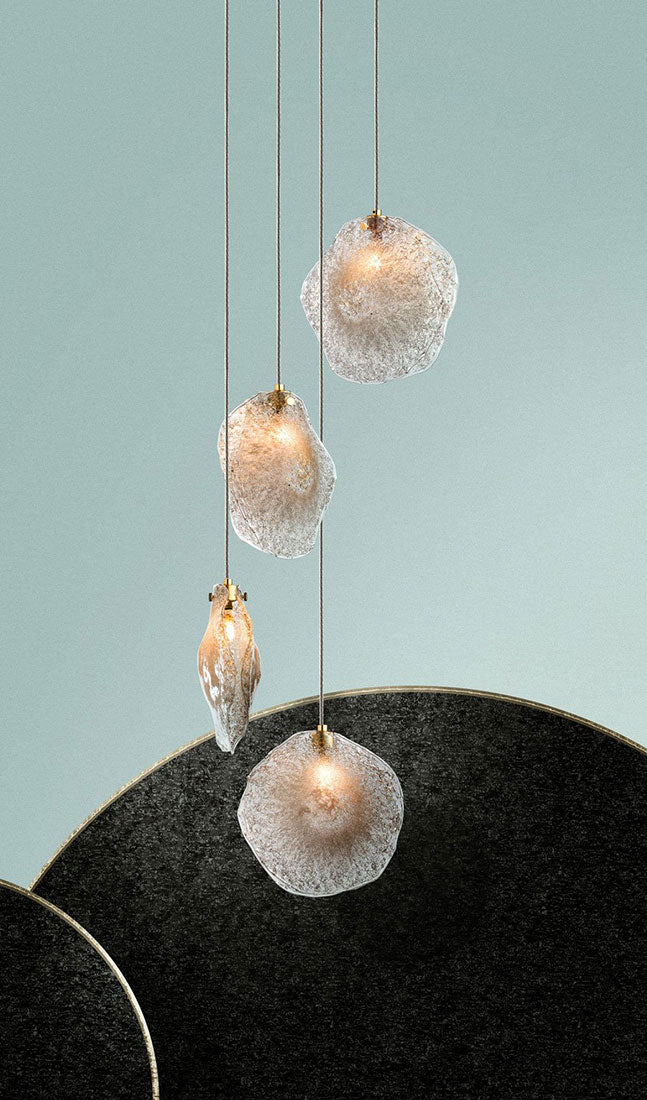


Designing a bespoke statement piece begins with the space, not the fixture. Ceiling height, room proportions, architectural features, materials, sightlines, electrical conditions, and the client's visual goals all influence what the final lighting installation should become.
At Shakúff, custom lighting is developed through a collaborative four-step process: discovery, design and appraisal, fabrication, and shipping. The objective is not simply to modify an existing light, but to create a sculptural fixture that responds to a specific interior while remaining structurally and technically considered.
The First Step Is Understanding the Space
A successful bespoke fixture needs a clear architectural context.
Before deciding on glass color or chandelier shape, the designer needs to understand where the piece will live. A double-height foyer presents very different opportunities from a dining room, staircase, or intimate seating area.
During Shakúff's custom lighting process, the discovery stage covers the scope of the project along with aesthetic and site-specific requirements. Clients can share photographs, drawings, videos, inspiration, preferred design styles, colors, and finishes. Structural details such as beams, lift systems, and electrical requirements are also considered at this stage.
This early information helps establish an important principle: a statement fixture should feel proportioned to the architecture rather than simply large or decorative.
A tall room may call for a pronounced vertical composition, while a long dining table could require a wider arrangement that reinforces the geometry below it.
Translating an Idea Into a Lighting Concept
Once the architectural conditions are understood, creative ideas need to become something that can actually be fabricated.
This is where proportion, material, glass form, pendant quantity, canopy shape, suspension, color, and visual weight begin to work together.
Shakúff describes its broader product-development philosophy as collaborative, combining creative thinking with engineering and continual refinement. Ideas move through sketching and prototyping before becoming finished fixtures. That balance between artistic intention and technical problem-solving is particularly important when designing one-of-a-kind lighting.
Existing Shakúff collections can also provide a starting language for customization.
For example, the Kadur Drizzle collection uses concentric glass spheres with drizzled glass fibers inside. The same visual language can move from a single pendant to much larger chandelier arrangements, making it possible to adapt density and scale without losing the identity of the glass form.
This modularity is useful because a bespoke statement piece does not always require inventing an entirely new visual vocabulary. Sometimes the strongest design comes from adapting an established form specifically to the space.
Scale and Composition Shape the Statement
A statement piece needs presence, but presence is not simply a matter of size.
Designers also consider density, spacing, transparency, vertical movement, and the relationship between individual glass components.
A fixture composed of many small transparent pendants can occupy significant architectural volume while remaining visually light. A single elongated glass element can create just as much impact through proportion and silhouette.
Shakúff's Tamar Grande Chandelier demonstrates the latter approach. Its rippled glass form is offered in substantial lengths and can extend through a generous vertical drop. The design was developed specifically with expansive interiors in mind, showing how scale can become part of the artistic concept rather than simply an enlarged version of a smaller fixture.
For clustered compositions, a design such as the Nimbus 14 works differently. It combines multiple smooth blown-glass orbs into a larger installation, with options for different glass sizes and customized fixture lengths.
Both approaches can create a focal point, but they interact with architecture in very different ways.
Material and Glass Character Define the Mood
After overall form comes materiality.
Glass is particularly expressive because its appearance changes with surrounding daylight, electric illumination, viewing angle, and surface treatment. Clear glass can preserve openness, while frost, amber, gray, or textured treatments can increase visual weight or warmth.
Shakúff's fixtures are handmade, and the studio notes that variations in size, color, shape, texture, bubbles, fissures, crackling, and crazing are inherent to the glass. These differences are part of the character of artisan-made material rather than something hidden from view.
The Mod 22, for example, uses individual pendants with a delicately perforated open-mesh texture. When multiple pieces are grouped into one chandelier, repetition creates order while the handcrafted surface keeps the installation from feeling mechanically uniform.
This is one of the advantages of bespoke glass lighting. The statement comes not only from the dimensions of the fixture, but from how light interacts with the material itself.
Rendering Helps Test the Design Before Fabrication
A bespoke fixture should not rely entirely on imagination.
During Shakúff's design and appraisal stage, engineers develop a structurally considered design and present the client with a 3D rendering, pricing, and specifications before fabrication begins. Any changes to the concept are finalized at this point.
This stage is especially valuable for large statement fixtures because scale can be difficult to judge from dimensions alone.
A chandelier may sound substantial on paper but still appear undersized beneath a high ceiling. Conversely, a dense cluster can dominate a room even if its overall measurements seem appropriate.
A rendering helps assess questions such as:
-
Does the fixture occupy enough of the architectural volume?
-
Does it interfere with important sightlines?
-
Is the composition too dense or too sparse?
-
Does the drop relate properly to the furniture or circulation below?
-
Does the canopy location make sense within the ceiling?
These questions are easier to solve before the piece enters production.
Fabrication Brings Craft and Engineering Together
Once the design is approved, the project moves into fabrication.
This is where the conceptual statement becomes a physical object. According to Shakúff's process, artisans form the glass into the required shapes, canopies are fabricated, and final finishing and assembly are completed by engineers and craftspeople at the Brooklyn studio.
The process demonstrates why bespoke lighting sits between decorative art and architectural product.
The glass needs to achieve the intended visual character, but the fixture also requires suitable hardware, suspension, canopy configuration, electrical integration, and structural planning.
A piece such as the Kadur Drizzle 19 illustrates how many variables can exist within a single chandelier design. The composition incorporates nineteen glass pendants, different glass sizes, several available glass treatments, canopy finishes, and options for customized fixture lengths.
When these elements are designed together rather than selected independently, the finished chandelier can feel more coherent within the room.
The Final Piece Must Work Within the Architecture
A statement fixture succeeds when it belongs to the space even while commanding attention.
That balance is important. A chandelier should not overwhelm the architecture simply because it is custom. Instead, its scale, material, spacing, and illumination should strengthen what is already distinctive about the room.
A dramatic staircase might benefit from a cascading composition that emphasizes movement. An expansive living room may need a larger grouping to bring the ceiling and seating area into better visual proportion. A restrained contemporary interior may call for one expressive glass form rather than many competing decorative elements.
Installation and maintenance should also be considered from the beginning, particularly for tall or complex fixtures. Shakúff designs its custom pieces with assembly and maintenance in mind, while shipping completed projects in protective custom packaging.
The finished installation is therefore the result of many connected decisions rather than a single decorative idea.
Explore Shakúff's handcrafted lighting collection or begin a bespoke project through the studio's custom process to create a statement piece shaped around your architecture, materials, proportions, and design vision.
Frequently Asked Questions
What makes a lighting fixture bespoke?
A bespoke lighting fixture is developed around the requirements of a specific project rather than selected only from predetermined dimensions and configurations. The design may consider room proportions, ceiling conditions, pendant quantity, glass form, colors, finishes, canopy design, suspension, and other architectural details before fabrication begins.
How does Shakúff begin a custom lighting project?
Shakúff begins with a discovery stage focused on understanding the project and the client's goals. Inspiration, photographs, drawings, preferred finishes, colors, structural details, electrical conditions, and other relevant information can be discussed before the fixture moves into design development.
Can an existing Shakúff fixture be customized into a statement piece?
Many Shakúff collections are designed to be customizable. Depending on the product, designers can explore different glass colors, dimensions, pendant quantities, finishes, suspension lengths, and arrangements. This allows an established collection to be adapted more specifically to the proportions and visual character of an individual interior.
Why is a 3D rendering important for custom lighting?
A 3D rendering helps clients and designers evaluate proportion and composition before fabrication. It can reveal whether the fixture feels appropriately scaled, how it relates to architectural features, and whether suspension or arrangement adjustments are needed. Shakúff incorporates a 3D rendering into the design and appraisal stage of its custom process.
How long does Shakúff's custom lighting process take?
Shakúff currently states that custom projects usually have a lead time of approximately 10 to 12 weeks, although timing can vary and expedited production may be discussed with its production manager. Project complexity, approvals, customization, and fabrication requirements can all influence the final schedule.