




The material presence of glass is woven into the fabric of everyday life. From the windows that frame our views to the vessels we hold, it is a substance so ubiquitous that its structural origins are rarely questioned. Yet, glass exists in two entirely different worlds. One is a world of mechanical precision, high-speed automation, and absolute uniformity. The other is a world of extreme heat, gravity, human breath, and ancient tradition.
In interior design and architectural lighting, choosing between machine-made and artisan-blown glass is not merely a matter of selecting a price point. It is a decision that dictates how light will behave within a room, how the object will age over decades, and whether a fixture will feel like a sterile mass-market commodity or a soulful work of art.
Understanding the structural, visual, and energetic discrepancies between these two manufacturing philosophies reveals why handcrafted glass remains the gold standard for luxury environments.
The Industrial Paradigm: How Machine-Made Glass is Formed
To appreciate the nuance of handmade art, one must first understand the mechanical systems it stands against. Industrial glass production is an engineering marvel designed to eliminate human variance. The process relies on automated press-and-blow or blow-and-blow machinery running continuously in massive foundry environments.
In a machine-driven facility, molten silica is fed into cast-iron or steel molds at precise microscopic increments. Automated plungers force compressed air into the mold, shaping the glass to the exact dimensions of the metal casing. The glass is then mechanically transferred to cooling tracks called lehrs, where the temperature is dropped at an identical rate across millions of units.

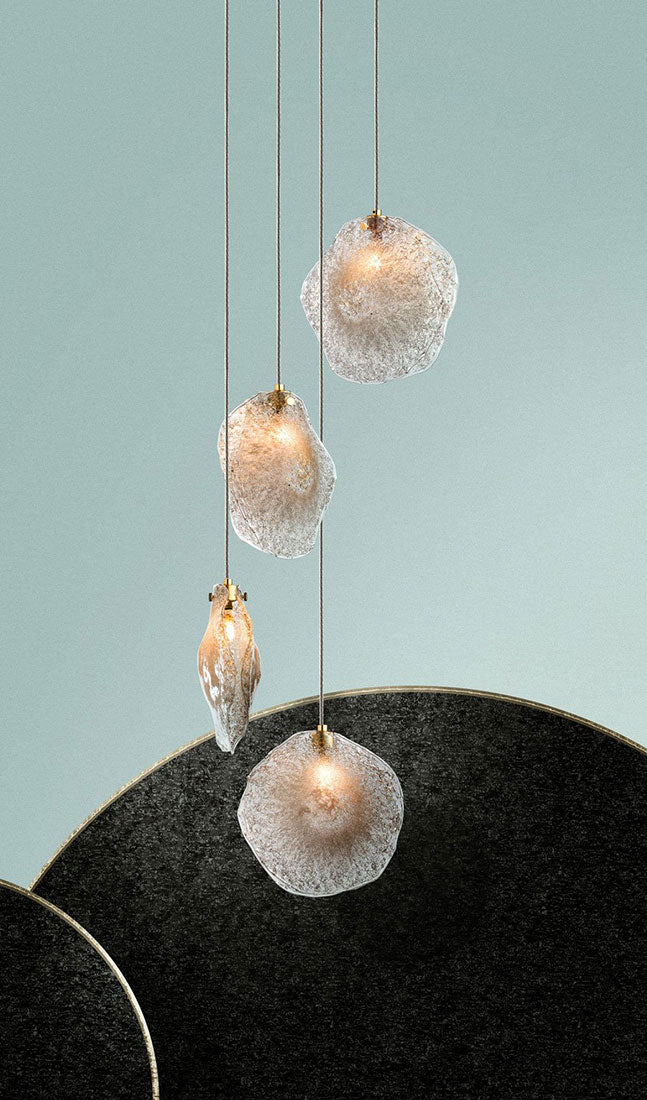
Artisanal glassblowing rejects standard machine molds to ensure every fixture possesses its own physical narrative.
The primary objective of this process is absolute consistency. A machine-made glass shade produced on a Monday morning will be mathematically identical to one produced on a Friday night. While this uniformity is advantageous for utilitarian items like laboratory beakers or commercial beverage bottles, it strips the material of its natural depth, optical complexity, and organic warmth when applied to decorative interior lighting.
Production Paradigm Highlights
| Industrial Production Attributes | Artisanal Blowing Attributes |
|---|---|
| • Steel molds compress the surface tightly | • Free-form shaping or graphite molds |
| • Absolute, mathematical identicality | • Micro-variations in wall thickness and shape |
| • Machine shear marks and visible structural seams | • Pontil scars and smooth, custom fire-polishing |
The Artisanal Journey: The Alchemy of Hand-Blown Glass
Artisan-blown glass is an ancient craft that has remained fundamentally unchanged for centuries, tracing its lineage back to the Roman Empire and the master glassblowers of Murano. It is a physically demanding discipline that requires an intuitive understanding of thermodynamics, fluid dynamics, and material endurance.
The process begins at the mouth of a furnace glowing at temperatures exceeding two thousand degrees Fahrenheit. A master glassblower gathers a precise amount of molten glass, known as a gob, onto the end of a hollow steel blowpipe. By gently blowing air through the pipe while continuously rotating the rod, the artisan creates an internal air pocket.
From this point, the glass is shaped using an array of simple hand tools, such as wooden blocks, metal jacks, and shears. The artisan must constantly balance the glass against the pull of gravity, utilizing centrifugal force and reheating the piece frequently in a secondary furnace called the glory hole.
Some artisanal pieces are blown into custom graphite or carved wooden molds to help regulate their general silhouette, but the final surface texture, wall thickness, and interior character are determined entirely by the breath, timing, and touch of the craftsman.
Structural Dissimilarities: Seams, Pontils, and Optical Clues
A trained eye can immediately differentiate a piece of machine-made glass from a handcrafted specimen by examining specific physical markers left behind by the production process.
Mold Seams vs. Fire-Polished Surfaces
Because machine-made glass is compressed inside multi-part steel molds, it almost always bears industrial artifacts known as mold seams. These are thin, raised lines where the pieces of the metal mold met during fabrication. While factories attempt to flame-polish or grind these seams down, they remain visible under close inspection.
Artisan-blown glass, particularly pieces shaped entirely by hand without a mold, features a continuous, seamless surface. When an artisan detaches the completed glass vessel from the blowpipe or a secondary iron rod called a pontil, it leaves behind a rough scar at the base known as a pontil mark. In premium lighting applications, this mark is meticulously ground down and fire-polished until it is perfectly smooth, serving as an authentic signature of genuine human craftsmanship.

Variations in glass thickness and internal seeds act as micro-lenses to scatter harsh glare gracefully.
Wall Thickness and Weight Distribution
Machines distribute molten material with clinical equality. A machine-molded glass globe will have a perfectly uniform wall thickness from its neck to its base. This sounds ideal, but it results in a flat, predictable appearance when illuminated.
Hand-blown glass features organic variations in weight and thickness. The glass is often slightly thicker at the base or around the curves where the molten material naturally pooled during rotation. This variation in density changes how weight is distributed, giving hand-blown fixtures a substantial, grounding presence when held or suspended.
The Optical Landscape: Light Interaction and Material Character
The most profound difference between automated and artisanal glass lies in its relationship with light. Glass is not merely a barrier for a light bulb; it is a lens that shapes the entire atmospheric quality of a space.
The Sterile Precision of Industrial Silica
Machine-made glass is highly refined to eliminate internal character. The raw materials are processed chemically to ensure the final product is free of bubbles, striations, or structural shifts. When light passes through a machine-made clear shade, it travels in straight, uninterrupted paths. While this clean transmission works well for utilitarian task lighting, it can result in a cold, unforgiving glare. The glass itself remains invisible, acting as a passive window rather than an active participant in the room's design palette.
Prismatic Depth and Living Imperfections
Hand-blown glass retains what artisans refer to as the memory of its creation. Because the material is manipulated while in a fluid, liquid state, it traps microscopic air bubbles, faint lines of movement, and subtle ripples within its walls. These features, often called seeds or cords, are not defects. They are prized structural characteristics that give handmade glass its unique value.
Optical Transmission Comparison
| Glass Type | Internal Artifacts | Behavior of Light Rays |
|---|---|---|
| Machine-Made | None (Sterile/Refined uniformity) | Straight, linear transmission; risk of raw glare. |
| Handcrafted | Seeds, ripples, organic striations | Refracted, rich multi-directional soft glow. |
According to optical engineering resources compiled by the Lighting Research Center, when light rays strike these internal variations, they are refracted and scattered in multiple directions rather than passing through cleanly. This scattering effect diffuses intense glare, transforming a harsh bulb into a rich, complex glow that casts dancing, water-like shadows across ceilings and walls.
Sustainability, Longevity, and Generational Value
In an economic landscape increasingly focused on environmental responsibility, the lifecycle of interior products has become a critical point of consideration for homeowners and architects alike.
Mass-produced glass items are treated as disposable commodities. Because they are manufactured rapidly in massive quantities, they carry little emotional attachment and are frequently discarded when interior trends shift or when a minor chip occurs. This cycle contributes to the mass manufacturing waste tracked by organizations like the U.S. Green Building Council.
Artisan-blown glass is built on the principle of permanent luxury. Because each piece is unique and requires hours of skilled human labor, it carries an inherent narrative value. A premium handcrafted installation is treated as an architectural asset or a family heirloom. If a homeowner relocates, high-end bespoke lighting is often carefully packaged and integrated into the next property, completely insulating the object from the wasteful cycles of disposable consumerism.
Bridging Art and Architecture with Bespoke Creation
When designing a home around natural materials like white oak, raw stone, or hand-loomed textiles, industrial glass can feel discordantly artificial. Handmade glass matches the tactile, honest energy of these premium elements because it shares an organic origin.

A completed artisan glass deployment bridges the gap between pure utility and fine art installation.
This seamless integration is precisely why luxury design studios reject mass-production models. Companies like Shakúff Luxury Lighting center their entire design philosophy on the unpredictable beauty of the human touch. By browsing their curated collections, you can observe how hand-blown elements are transformed into cohesive architectural experiences.
Whether it is the rain-streaked interior of a Kadur Drizzle pendant or the watery, ocean-inspired form of a custom chandelier, these fixtures lean into the natural variations that only artisan glass blowers can achieve. This collaborative relationship between raw heat and human intent ensures that your lighting installation serves as a functional art piece tailored to the exact scale, color story, and mood of your home.
If you are ready to move away from the cold predictability of machine-made fixtures and introduce the rich, refracted warmth of authentic, artisan-blown glass into your next interior project, we invite you to consult with the design specialists at Shakúff. Connect with our specialized team today to explore our customizable options, review physical glass samples, and begin co-creating a bespoke lighting installation that brings true artistic heritage and timeless soul into your living space.