




Choosing the right chandelier for high ceilings comes down to more than finding a large fixture. Scale, vertical drop, proportion, visual weight, and placement all need to work with the architecture of the room.
In double-height living rooms, stairwells, foyers, and vaulted spaces, a chandelier has a unique role. It can connect upper and lower areas of the room, create a strong focal point, and bring light into a volume that might otherwise feel visually empty.
For Shakúff, this is where customizable glass lighting becomes especially relevant. Rather than treating a chandelier as a fixed object, the studio offers compositions that can be adapted through glass color, fixture size, suspension length, finishes, and pendant arrangements depending on the collection.
Start With the Scale of the Room
A chandelier for a high ceiling should be proportioned to the entire room, not simply the ceiling height.
Begin by considering the room's width and length, the ceiling height, the furniture below, surrounding architectural details, and the main viewing angles. A chandelier in a tall but narrow stairwell requires a different composition from one suspended over an expansive dining table.
The most effective fixture does not necessarily have to be visually heavy. A chandelier can occupy a significant volume while remaining relatively open and transparent.
Shakúff's chandelier collection demonstrates this clearly. Many designs use individual glass elements grouped into larger compositions, allowing the fixture to establish scale through repetition and spacing rather than a single massive form.
This approach is particularly useful in modern interiors where designers may want a strong centerpiece without blocking windows, artwork, or architectural sightlines.
Use the Ceiling Height Instead of Fighting It
High ceilings create an opportunity to design vertically.
A chandelier suspended too close to a tall ceiling may appear disconnected from the occupied part of the room. Bringing the composition lower can visually connect the ceiling with furniture, staircases, or circulation areas below.
In a double-height foyer, for example, a cascading composition can draw the eye upward while still relating to people entering at ground level. In a dining room, the fixture may sit considerably lower because the table establishes a protected zone beneath it.
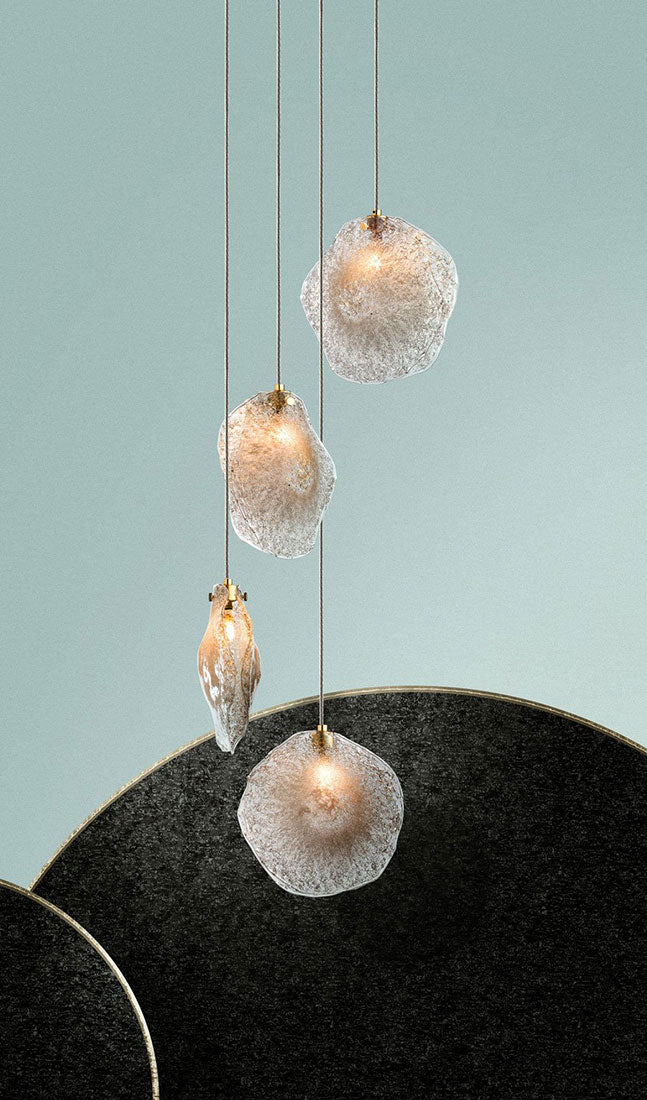
Shakúff's Kadur Drizzle Chandeliers are particularly suited to this type of planning because the pendants can be suspended at similar or staggered heights. The collection also allows fixtures to be made with wires or rods, giving designers flexibility in how the composition occupies vertical space.
The important question is not simply, "How high is the ceiling?" It is, "Where should the chandelier sit within that height?"
Consider Width, Drop, and Visual Weight Together
Chandelier dimensions should never be evaluated independently.
A wide fixture with a shallow drop behaves very differently from a narrow chandelier extending several feet downward. Both can work in a high-ceiling room, but they address the architecture differently.
Visual weight is equally important.
Transparent and translucent glass can allow a large fixture to retain a sense of openness. More concentrated forms, darker finishes, or densely grouped elements create greater visual presence even when their physical dimensions are similar.
Shakúff's Kadur Drizzle 19, for example, groups multiple concentric blown-glass spheres into a larger chandelier. The pendant arrangement can be customized, and custom-length fixtures are available, allowing the composition to respond to the proportions of a particular interior.
This flexibility is valuable when a room needs substantial scale without introducing a visually solid mass overhead.
Choose a Form That Complements the Architecture
The shape of the chandelier should respond to the shape of the room.
A long dining table often benefits from a more linear or elongated fixture. A tall entrance hall may call for a vertically oriented composition. A large square or circular room can support a more centralized chandelier.
One example designed specifically with expansive spaces in mind is Shakúff's Tamar Grande Chandelier.
Its elongated rippled glass is available in five-foot or seven-foot lengths, with an overall height ranging from two to fifteen feet. Shakúff describes the modular design as intended for expansive interiors, making it particularly relevant for rooms where conventional chandelier dimensions would appear underscaled.
The form also illustrates an important design principle: a chandelier for a high ceiling does not need to resemble a traditional tiered fixture. Contemporary glass lighting can create scale through long vertical forms, clusters, suspended elements, or repeated sculptural shapes.
Think About How the Chandelier Looks From Every Level
High-ceiling chandeliers are often viewed from more than one perspective.
A fixture in a double-height space may be visible from the entrance, an upper landing, a staircase, adjacent rooms, and even through exterior glazing. A composition that appears balanced from directly below may feel entirely different when seen from the second floor.
Before finalizing the design, consider:
-
The primary entrance into the room
-
Views from upper floors or balconies
-
Sightlines through nearby rooms
-
The relationship with windows and artwork
-
How the fixture appears during the day as well as at night
This is one reason custom planning can be valuable for tall interiors.
Shakúff's custom lighting process begins by considering project requirements, aesthetic preferences, structural details, beams, electrical conditions, and other site-specific information. During the design stage, the studio prepares a 3D rendering so the proposed fixture can be evaluated before fabrication.
That process allows scale and arrangement to be addressed before the chandelier physically occupies the room.
Use Glass to Manage Presence and Light
Material selection becomes particularly important as chandeliers increase in scale.
Glass can occupy a large architectural volume while preserving transparency and visual depth. It can also introduce surface texture, reflections, color, and subtle variation without making the fixture feel excessively heavy.
The way glass is treated influences the overall character of the chandelier.
In Shakúff's Kadur Drizzle collection, for example, drizzled glass fibers are enclosed within an outer glass sphere. The layered material gives each element internal detail while the transparent exterior preserves a sense of openness.
Handcrafted glass also means minor variations naturally occur between individual elements. Shakúff notes that variations in size, color, shape, texture, fissures, bubbles, crackling, and crazing are inherent characteristics of its handmade glass.
In a large chandelier, those differences can create a more organic visual rhythm than perfectly identical components.
Layer the Chandelier With Other Lighting
Even a dramatic high-ceiling chandelier should not automatically be expected to illuminate the entire room on its own.
Good residential lighting usually combines several layers. The U.S. Department of Energy describes ambient, task, and accent lighting as distinct functions within a lighting plan. Ambient lighting supports general illumination, task lighting serves specific activities, and accent lighting creates visual emphasis.
In a high-ceiling living room, the chandelier may establish the main visual focus while floor lamps, sconces, architectural lighting, or localized fixtures bring illumination closer to seating and working areas.
This also gives the room more flexibility. A chandelier can provide atmosphere and architectural presence without having to perform every lighting function simultaneously.
Plan Customization and Installation Early
Large chandeliers require early coordination.
Suspension lengths, canopy dimensions, ceiling structure, electrical locations, access for installation, and long-term maintenance should all be considered before the room is complete.
This becomes even more important for custom compositions with numerous glass elements.
For example, Shakúff's Kadur Drizzle 22 uses a 22-pendant composition and offers custom-length options with wires or rods. Its scale illustrates why canopy placement and ceiling preparation should be considered as part of the architectural planning rather than after finishes are complete.
When architects, interior designers, electricians, and lighting specialists coordinate early, the chandelier can feel integrated into the room rather than added after the fact.
For high ceilings that require a fixture shaped around the architecture, explore Shakúff's handcrafted chandelier collection or work with the Brooklyn studio on a custom composition designed around your room's scale, ceiling conditions, materials, and sightlines.
Frequently Asked Questions
What type of chandelier is best for a high ceiling?
The best chandelier depends on the dimensions and architecture of the room. Double-height foyers often work well with vertically arranged or cascading fixtures, while broad living and dining areas may benefit from wider compositions. Focus on the relationship between chandelier width, overall drop, furniture placement, sightlines, and the visual volume of the room.
How low should a chandelier hang from a high ceiling?
There is no single correct drop for every high-ceiling room. The ideal height depends on circulation below the fixture, ceiling height, furniture placement, and how the chandelier is viewed from different levels. Fixtures above dining tables can generally hang lower, while chandeliers above open walking areas require greater clearance.
Are glass chandeliers suitable for double-height rooms?
Yes. Glass can work especially well in double-height spaces because it allows a chandelier to occupy significant volume without necessarily appearing visually heavy. Transparent and textured glass can interact with daylight, architectural lighting, and surrounding materials while maintaining open sightlines through the fixture.
Can a chandelier be customized for an unusually high ceiling?
Yes. Shakúff offers customizable lighting options, and some collections allow adjustments to suspension length, pendant quantity, glass color, arrangement, and finishes. The studio's custom process also considers structural and electrical conditions before fabrication, making it possible to develop a fixture around an unconventional or especially tall space.
Should a chandelier be the only light source in a high-ceiling room?
Usually not. A chandelier can provide ambient light and act as the room's main visual feature, but additional lighting is often useful closer to the occupied level. Combining a chandelier with sconces, floor lamps, task lighting, or architectural lighting can provide better functional illumination while adding depth to the overall lighting scheme.