


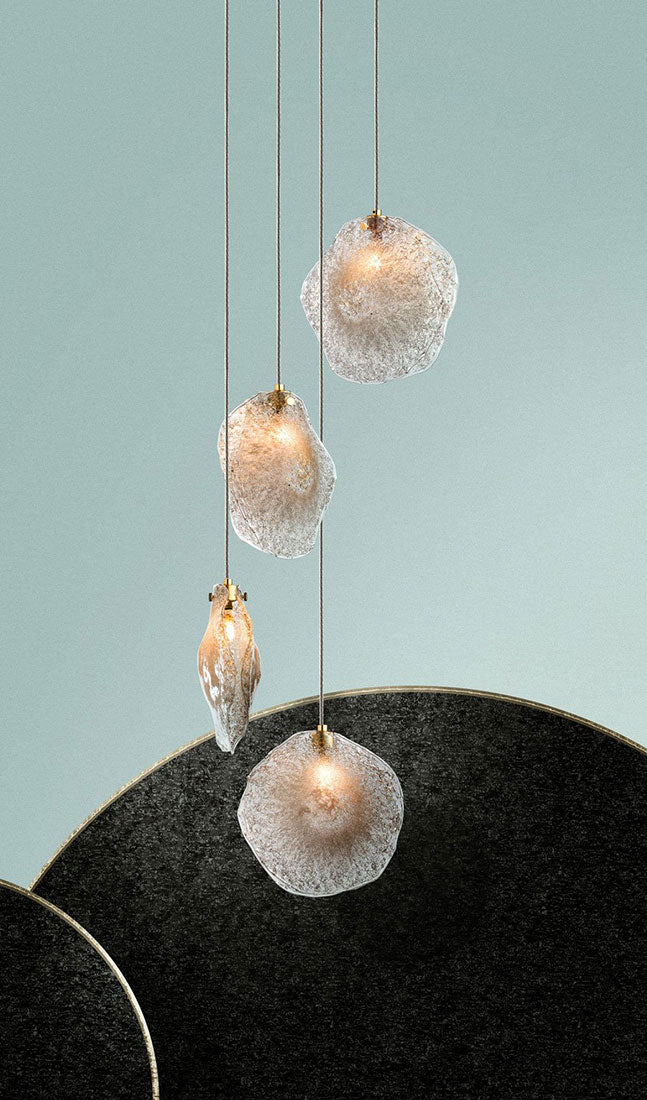


A luxury custom chandelier is far more than a source of light. It is a massive, suspended work of fine art. When you look up at a cluster of delicately textured, colorful glass pendants gracing a grand entryway or a dining room, you are looking at the culmination of centuries of physical mastery, extreme heat, and intense collaboration.
The ancient art of glassblowing has remained remarkably unchanged since its origins in the Roman Empire during the first century BCE. It relies on the same fundamental elements: fire, wind, iron, and gravity.
This guide pulls back the curtain of the hot shop to show exactly how master glass artists turn raw, powdery sand into a breathtaking, handcrafted glass masterpiece.

The Chemistry of Glass: The Raw Materials
Before an artisan ever picks up a blowpipe, they must mix the batch. Glass is not a simple solid; chemically, it is an amorphous solid, meaning its molecules are highly disorganized like a liquid, but locked rigidly in place. According to the Corning Museum of Glass, standard studio glass consists of three primary ingredients:
-
Silica (Silicon Dioxide): Found in pure sand, this forms the structural matrix of the glass. Because silica has an extremely high melting point of about 3,000°F (1,700°C), other materials must be added to make it workable in a standard studio furnace.
-
Soda Ash (Sodium Carbonate): This acts as a fluxing agent, lowering the melting temperature of the silica to a manageable 2,400°F (1,315°C).
-
Lime (Calcium Carbonate): Soda ash makes glass water-soluble. Adding lime stabilizes the mixture, preventing the finished glass from degrading when exposed to humidity or atmospheric moisture over decades.
To achieve the vibrant custom colors seen in luxury lighting, artisans fold mineral oxides into the molten glass batch.
|
Metal Additive |
Resulting Glass Color |
|
Cobalt Oxide |
Intense, deep royal blue |
|
Gold Chloride / Selenium |
Brilliant ruby reds and pinks |
|
Copper Oxide |
Turquoise, light blues, and soft greens |
|
Iron Oxide |
Forest greens, ambers, and warm olive tones |
|
Uranium / Cadmium |
Vibrant yellows and fluorescent greens |

Inside the Studio: How a Hand-Blown Glass Chandelier Is Made, Step by Step
Crafting a large-scale chandelier requires a highly coordinated dance between the master glassblower (known as the gaffer) and their team of skilled assistants. Because molten glass cools and solidifies within minutes, every movement must be planned, timed, and executed with split-second precision.
Here is the step-by-step process of how individual art glass elements are created and assembled.
1. Melting the raw batch: 12 hours prior.
The raw ingredients are shoveled into a massive clay crucible inside the main furnace. The furnace burns continuously at roughly 2,100°F to 2,400°F. Overnight, the ingredients melt into a consistency resembling hot honey, releasing all trapped air bubbles.
2. Gathering the glass: Temp: 2,100°F.
The gaffer dips the preheated tip of a hollow stainless-steel blowpipe (called a punty) into the furnace. They rotate the pipe constantly to wrap a ball of glowing, molten glass around the end, a process akin to twisting a honey dipper.
3. Marvering and centering: Sizing and smoothing.
The gaffer rolls the hot glass on a thick steel table called a marver. This cools the outer layer of the molten mass, creating a slight "skin" that helps center the glass on the pipe and shapes it into a uniform cylinder.
4. Starting the bubble: Introducing the air pocket.
The gaffer blows a short, quick puff of air into the cool end of the pipe and quickly caps the mouthpiece with their thumb. The heat causes the trapped air to expand, pushing a small, perfectly centered bubble into the molten glass.
5. The second gather: Building volume.
To create a larger chandelier element, the gaffer dips the pipe back into the furnace for a "second gather," wrapping another layer of molten glass directly over the initial bubble.
6. Shaping and texturing: Molds and hand-tools.
The team uses cherry-wood blocks, heavy steel shears, and damp newspaper to shape the glass. To create distinct custom designs, they may blow the glass into custom molds or roll it over textured metal plates to produce finishes like seeded, drizzled, or ribbed patterns.
7. Transferring to the punty: The hand-off.
To open and shape the top of the glass pendant, the gaffer must transfer it to a solid metal rod called a punty. An assistant attaches the hot punty to the bottom of the glass vessel. The gaffer then drips a drop of cold water onto the neck of the glass near the blowpipe and taps it sharply, cracking the glass cleanly away from the blowpipe while leaving it attached to the punty.
8.Annealing the glass: Slow cooling process.
Once the final shape is achieved, the glass is cracked off the punty and quickly placed into a specialized oven called an annealer or lehr. The annealer is programmed to slowly lower the temperature of the glass from 900°F to room temperature over 12 to 24 hours. This slow process relieves internal thermal stresses. If cooled too quickly, the glass would explode under tension.
Cold Working: Refining and Perfecting the Pieces
Once the glass pieces emerge cool from the annealing oven, they enter the cold working studio. Here, artisans use water-cooled diamond-grit saws, grinding wheels, and polishing laps to refine each piece.
They slice off rough edges left behind from the punty, drill precise entry holes for electrical sockets, and polish the glass edges until they are perfectly smooth and optically clear. Each individual pendant is then washed, inspected for structural integrity, and carefully sorted.
Designing the Structural Skeleton: Canopy and Wiring
A bespoke modern custom chandelier is not simply a collection of glass globes hanging from standard wires. It requires a heavy-duty, engineered structure to support its weight and distribute the electrical load.
Custom Metal Canopies
Because glass is heavy, a chandelier with dozens of individual drops can easily weigh between 50 and 300 pounds. Engineers design heavy-gauge metal ceiling plates (canopies) that mount directly to the structural ceiling joists of a home. These canopies are finished in custom textures, such as brushed brass, matte black, or polished chrome, to complement the room's interior design.
Precision Wiring and Suspensions
Each glass element is hung using reinforced, field-adjustable coaxial cables. These cables contain both the high-strength steel tension wire to hold the physical weight of the glass and the insulated copper conductors that carry low-voltage electricity to the LEDs.

Why Handmade Art Glass Differs from Factory Molded Glass
When investing in high-end residential lighting, understanding the structural and aesthetic differences between hand-blown art glass and machine-pressed factory glass is essential.
The National Endowment for the Arts (NEA) emphasizes that traditional craft practices preserve unique material behaviors that industrial automation cannot duplicate.
|
Feature |
Hand-Blown Art Glass |
Machine-Pressed Glass |
|
Thickness |
Varies subtly throughout the piece, creating deep, rich light refractions |
Completely uniform, resulting in a flat and sterile appearance |
|
Symmetry |
Organic, soft variations that show the hand of the artisan |
Artificially perfect, identical duplicates |
|
Optical Clarity |
Features tiny, unique "seeds" (air bubbles) and swirl marks (pontil scars) |
Flat, sterile finish with visible mold seam lines |
|
Light Diffusion |
Softly refracts light across room surfaces, eliminating harsh glares |
Focuses light into sharp, intense hotspots |
Preparing for a Custom Glass Chandelier Installation
If you are planning to install a large-scale hand-blown glass chandelier in your home, keep these crucial preparation steps in mind:
1. Structural Support
Standard ceiling electrical boxes are only rated to hold fixtures up to 50 pounds. For larger, multi-pendant chandeliers, your builder or general contractor must install a heavy-duty support brace, typically made of $2 X 6$ or $2 X 8$ wood blocking, directly above the drywall to secure the canopy screws.
2. Shipping and Unboxing
Hand-blown glass elements are incredibly delicate. When ordering custom art glass, the pieces are packed in heavy-duty foam or custom suspension boxes.
Keep the glass securely packed in its original boxes until your electrician has completely finished mounting the ceiling canopy and hanging the cables. Only hang the delicate glass elements at the very end of the installation process.
3. Cleaning and Long-Term Maintenance
To preserve the brilliance of your art glass, clean it regularly. Once or twice a year, use a clean, dry microfiber cloth to gently wipe away dust. Avoid using abrasive household chemical cleaners, which can gradually wear down delicate glass treatments or metal finishes.
Artisan Note: The small imperfections, subtle color shifts, and tiny air bubbles locked inside hand-blown glass are not defects. They are the "signature" of the glassblower, proving that your light fixture was shaped by human hands and exists as a one-of-a-kind original.