


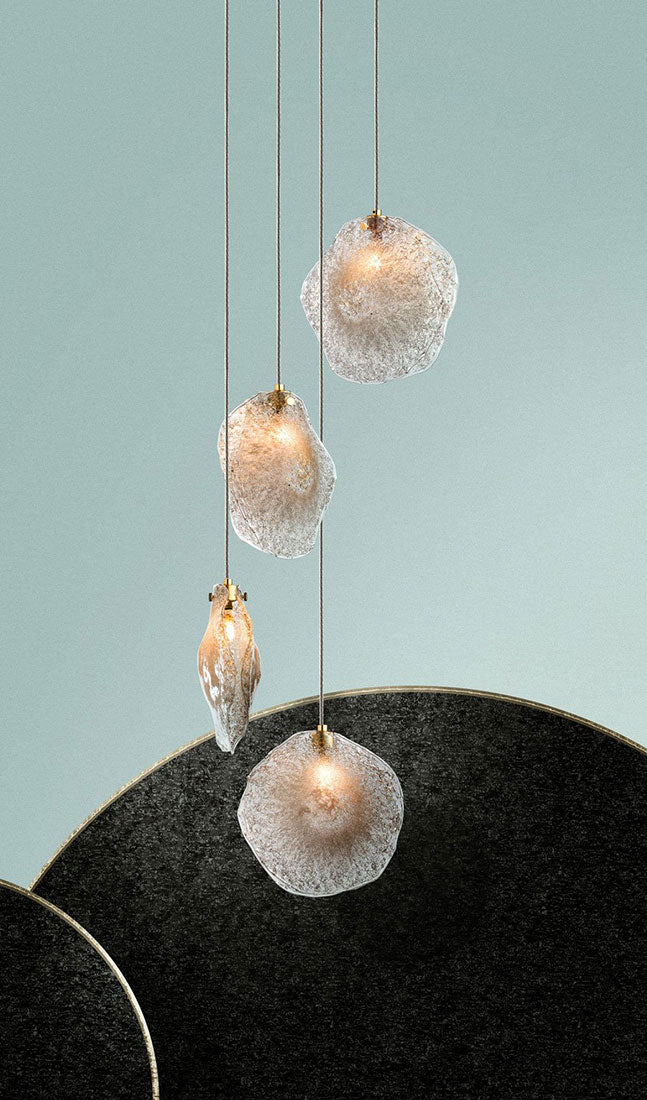


In the realm of high-end interior architecture, a profound shift has occurred: lighting is no longer treated as a late-stage secondary accessory chosen to fill a ceiling junction box. Instead, leading designers approach illumination as the primary anchor around which an entire interior composition revolves. When a space is designed around a central statement fixture, light transitions from a passive, functional necessity into an active architectural material. A sculptural glass installation establishes spatial rhythm, directs sightlines, and dictates the material and color palettes of the surrounding environment. At Shakúff, an Industry City, Brooklyn-based handcrafted lighting studio led by CEO Josef Sidof and Product Designer Sophia Han, this philosophy guides every commission. By pairing traditional glassblowing mastery with tailored architectural engineering, bespoke lighting transforms static rooms into dynamic, curator-level environments.
Light, Texture, and Imperfection: The Soul of Hand-Blown Glass

Designing a room around a central light fixture requires a material capable of commanding visual attention even when unlit. Factory-cast, mass-produced glass relies on automated machine molds to achieve absolute uniformity. However, this sterile perfection transmits light in flat, unyielding rays that cast harsh glare and uninviting, cold shadows across an interior.
Studio-crafted hand-blown glass operates on a fundamentally different optical level. Worked by hand at extreme temperatures, molten silicate captures and locks in physical artifacts of its creation. Microscopic seed bubbles, fluid drizzle textures, delicate surface crackling, and organic fissures are permanently held within each glass element. These subtle variations transform every pendant into an active optical lens.
Rather than allowing electric light to pass straight through, these internal textures fracture illumination into thousands of multi-directional beams. Light scatters softly across surrounding architectural surfaces, casting a warm ambient glow over natural stone, rich timbers, and woven textiles. Inspired by fluid natural forms, such as coastal tides and water movement seen in signature styles like Tamar and Kadur Drizzle, these glass elements interact continuously with their environment. During daylight hours, unlit glass catches natural sunlight, projecting subtle reflections throughout the room. At night, internal illumination transforms the installation into a glowing, multi-dimensional light sculpture. To explore the material science, optical refraction, and historical evolution of manipulated silicate, examine the research archives curated by the Corning Museum of Glass.
Bespoke Customization: Scaling Light to Architectural Volume
When a statement fixture serves as the focal point of a room, whether in a grand double-height foyer, a multi-tier stairwell, or an expansive open-plan living area, its proportions must respond directly to the surrounding architectural volume. An undersized fixture dissolves within a large air void, failing to establish spatial authority, while an improperly proportioned piece can overpower seating arrangements and disrupt sightlines.
Achieving complete harmony requires a flexible, modular framework. At Shakúff, individual hand-blown glass pendants are treated as sculptural elements that can be grouped, scaled, and tailored to fill specific architectural blueprints. When designing an interior around a central fixture, designers can customize four key structural parameters:
-
Tailored Canopy Geometries: Custom-fabricated ceiling canopies engineered in circular, rectangular, or irregular footprints in hand-applied finishes, such as brushed brass, oil-rubbed bronze, or matte powder coating, to integrate cleanly with structural ceiling planes.
-
Variable Cable & Rod Suspensions: Coaxial cabling and rigid stems cut to precise, staggered lengths, allowing individual glass elements to cascade through vertical spaces without obstructing sightlines.
-
Custom Glass Formulations: Blending custom glass hues, combining clear drizzled textures with subtle tones of smoke, amber, or steel blue, to harmonize with the surrounding interior color palette.
-
Scalable Element Counts: Installations can be specified with anywhere from three isolated pendants over a side table to over one hundred glass elements cascading down a central stairwell.
To see how tailored canopy dimensions, custom drop lengths, and element counts are engineered for specific architectural layouts, explore the Shakúff Chandeliers Collection and review our four-step collaborative workflow on the Shakúff Custom Process Page.

Mass-Produced Lighting vs. Bespoke Hand-Blown Glass
When committing to a design centered on a focal light source, selecting studio-crafted glass over mass-market fixtures ensures long-term aesthetic and optical success. The comparison table below highlights the key differences between standardized manufacturing and bespoke artisan glass installations.
|
Design Attribute |
Mass-Produced Fixtures |
Bespoke Hand-Blown Glass |
|
Manufacturing Process |
Automated machine mold casting; high-volume uniform output |
Hand-blown artisan production; individual studio crafting |
|
Optical Quality & Diffusion |
Direct, flat light transmission; prone to glare and harsh shadows |
Multidimensional refraction; organic texture creates soft ambient glow |
|
Customization Potential |
Fixed dimensions, standardized finishes, static drop lengths |
Tailored scale, custom element counts, bespoke glass hues, and metal finishes |
|
Spatial Integration |
Isolated standalone items; limited architectural harmony |
Fully integrated within architectural volume and interior proportions |
|
Material Longevity |
Thin industrial coatings; susceptible to quick trend obsolescence |
Heirloom-quality glass artistry; timeless material value and structural durability |
Strategic Room Integration: Balancing Task and Ambient Glow
When a room is anchored by a primary statement fixture, secondary lighting layers must be carefully orchestrated to support, rather than compete with, the central sculpture. A masterfully executed interior layers task, accent, and ambient illumination to create depth and balance.
-
Culinary Islands & Dining Spaces: Over central kitchen islands and dining tables, hand-blown pendants act as key structural anchors. Styles featured in the Shakúff Pendants Collection direct focused downlight onto prep and dining surfaces while emitting a gentle radial glow that illuminates faces comfortably without glare.
-
Grand Foyers & Commercial Lounges: In expansive entry halls, double-height great rooms, or hospitality lounges, multi-tier glass chandeliers serve as monumental focal points. By suspending handcrafted glass elements at varying heights, these installations bridge the gap between floor-level seating and high ceiling planes.
For technical guidelines on calculating foot-candles, managing glare, and specifying architectural controls across luxury projects, refer to the educational resources published by the International Association of Lighting Designers.
A Step-by-Step Selection Guide for Designers
To design a high-end interior seamlessly around a custom statement lighting fixture, follow this structured five-step designer workflow:
Step 1: Establish the Architectural Anchor. Identify the primary focal zone of the room, such as the center of a double-height volume, the axis of a dining table, or the well of a winding staircase, where the fixture will hang.
Step 2: Map Proportions and Sightlines. Calculate spatial volume, ceiling clear heights, and sightlines from entry points and adjacent rooms. Determine the necessary diameter, drop length, and visual density required to command the space.
Step 3: Derive the Material Palette from the Glass. Use the colors, textures, and metal canopy finishes of the statement fixture to inform the selection of surrounding interior materials, such as stone slabs, wood paneling, and upholstery fabrics.
Step 4: Layer Supporting Lighting Circuits. Integrate discrete, dimmable secondary lighting, such as architectural cove lighting or low-profile accent spots, to balance ambient light levels without visually distracting from the main glass installation.
Step 5: Fine-Tune Installation Heights On Site. During final mounting, adjust individual cable drops to ensure the sculptural glass cluster flows naturally with the room's architecture and maintains comfortable clearance.
Elevate Your Interiors with Studio Glass Artistry
Designing a room around a bespoke hand-blown glass fixture allows interior designers and architects to create spaces with uncompromised artistic integrity. By honoring organic glass textures, tailored structural scaling, and deliberate craftsmanship, you provide a radiant architectural centerpiece that elevates a residence into a curator-level environment.
At Shakúff, our Brooklyn studio in Industry City collaborates directly with trade professionals to develop, visualize, and fabricate custom lighting solutions tailored to exact project specifications. Guided by CEO Josef Sidof and Product Designer Sophia Han, our team bridges ancient glassblowing traditions with modern architectural engineering.
We invite you to visit our Industry City showroom in Brooklyn or submit your architectural plans for a collaborative design consultation. Contact our trade team today at Shakúff to begin shaping light for your next interior vision.