


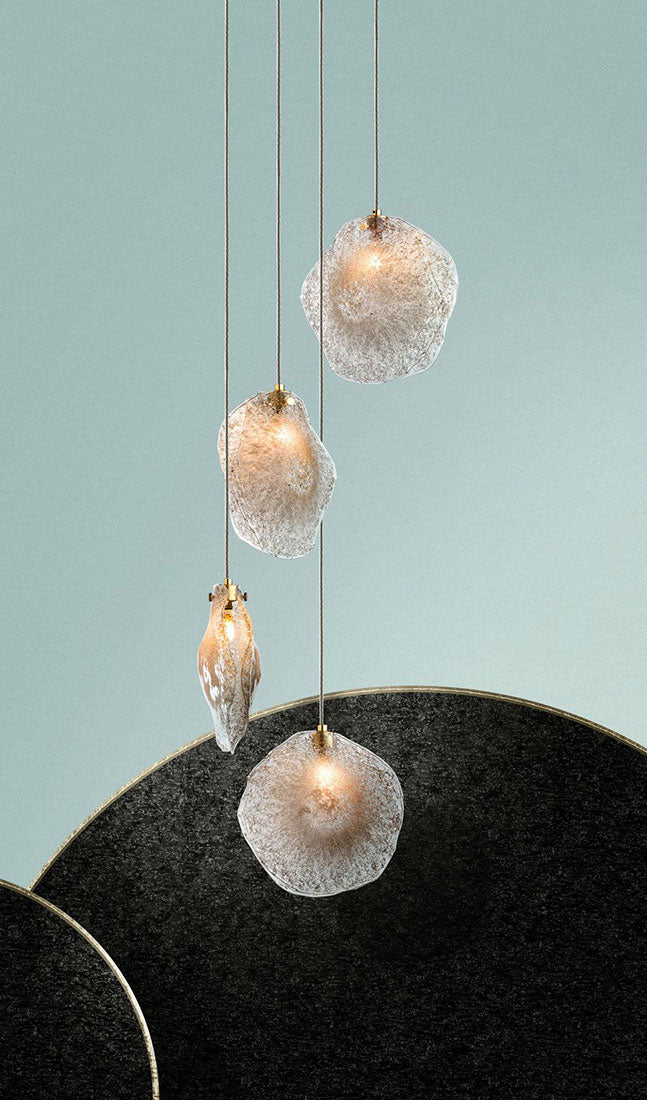


Minimalist modern lighting is becoming more expressive. Rather than filling a home with decorative fixtures, designers are choosing fewer pieces with stronger forms, richer materials, and a clearer relationship to the architecture.
For luxury homes, this means moving beyond anonymous recessed lighting and overly simple geometric fixtures. The most compelling minimalist interiors now balance clean lines with handcrafted glass, sculptural silhouettes, subtle texture, warm materials, and carefully controlled scale.
Shakúff's customizable lighting collections demonstrate how this approach can work. Individual fixtures remain visually disciplined, but details such as hand-blown glass, metal finishes, pendant arrangements, and material variation give them character without creating unnecessary visual clutter.
Sculptural Lighting Is Replacing Invisible Lighting
Minimalism once encouraged lighting to almost disappear into the ceiling. Contemporary luxury interiors are taking a different approach.
Instead of eliminating decorative fixtures altogether, designers are using one sculptural chandelier or pendant installation to establish the focal point of an otherwise restrained room. The surrounding architecture can remain clean and uncluttered because the lighting carries much of the visual interest.
This works particularly well in entryways, dining areas, open living spaces, and double-height rooms.
A fixture such as the Tamar Grande Chandelier illustrates the idea. Its elongated rippled-glass form creates movement without relying on elaborate ornamentation. Shakúff offers it in five-foot or seven-foot lengths with drops extending up to fifteen feet, allowing the fixture to respond to expansive architectural spaces.
The minimalist principle remains intact: fewer objects, chosen with greater intention.
Textured Glass Adds Depth Without Visual Clutter
Minimalist interiors frequently use restrained color palettes, making texture increasingly important.
When walls, flooring, cabinetry, and furniture rely on subtle tonal differences, lighting can introduce another layer of material depth. Hand-blown glass is particularly suited to this because texture can create interest without requiring bold colors or ornamental forms.
Shakúff's Mod collection uses blown-glass orbs with a perforated, mesh-like texture. The basic spherical silhouette remains simple, while the glass surface produces a more complex interaction between illumination and shadow.
This is an effective strategy for minimalist modern interiors. Instead of adding more decorative objects, designers can allow surface, light, and material to provide detail.
The result feels considered rather than sparse.
Organic Forms Are Softening Modern Architecture
Minimalist homes are also moving away from exclusively rigid geometry.
Straight architectural lines still have an important place in modern design, but lighting increasingly introduces curves, asymmetry, and naturally inspired forms that soften the overall composition.
Rounded glass pendants can balance rectilinear cabinetry. Flowing chandeliers can offset concrete or stone surfaces. Slightly irregular handmade elements can introduce a human quality to otherwise highly controlled interiors.
The Nimbus collection is a good example. Its smooth glass forms are available in chandelier, pendant, and sconce configurations, with fixtures that can be arranged at similar or staggered heights. Glass and hardware options provide additional opportunities to adapt the composition to the surrounding materials.
Rather than interrupting minimalist architecture, these softer shapes create contrast while preserving visual restraint.
Warm Metals Are Taking the Edge Off Minimalism
Cool metals and monochromatic black fixtures have long been associated with modern interiors, but warmer finishes are playing a greater role in refined minimalist spaces.
Brushed brass, antique bronze, and other muted metal finishes can add warmth without becoming overly decorative. They pair naturally with materials such as walnut, limestone, marble, plaster, and warm neutral fabrics.
Shakúff's collections offer finishes including brushed brass, brushed nickel, antique bronze, matte silver, and other options depending on the fixture.
The goal is not to make hardware the dominant element. In successful minimalist lighting, metal details often act as a quiet bridge between the glass fixture and the surrounding architecture.
Shakúff's Nimbus Luxe Sconce, for example, combines a restrained glass form with solid brass components. Used along a hallway, beside a mirror, or as part of a layered living-space scheme, a fixture like this can introduce material richness without overwhelming the wall.
Custom Pendant Compositions Are Becoming More Architectural
One of the most useful developments in minimalist modern lighting is the shift from fixed chandelier shapes toward customizable pendant compositions.
Rather than selecting a predefined fixture and forcing it into the room, designers can use repeated glass elements to respond to the architecture.
A narrow stairwell might call for a vertical arrangement. A dining area could use a wider composition above the table. A double-height foyer might benefit from pendants suspended at multiple levels.
Shakúff's Kadur Drizzle collection is designed with this type of flexibility. Its concentric glass orbs incorporate internal drizzled glass fibers, and the collection can be configured as chandeliers, pendants, floor lamps, and table lamps. Pendant arrangements can also use similar or staggered heights.
This approach is especially compatible with minimalist architecture because repetition creates visual rhythm without requiring complicated ornament.
Natural Stone and Glass Are Creating More Refined Material Palettes
Minimalist lighting is also becoming more material-focused.
Rather than relying only on painted metal and clear glass, sophisticated interiors are incorporating natural stone, textured glass, and warmer finishes that coordinate with the rest of the home's material palette.
Shakúff's Bloom collection combines blown glass with material options including white onyx, white marble, black marble, brushed nickel, and brushed brass.
This type of material combination can be particularly effective in minimalist interiors because each element has room to be noticed.
A marble component does not need elaborate detailing when its natural veining already creates variation. Likewise, handmade glass can contribute subtle irregularity through texture and form.
The emphasis shifts from decoration to material quality and composition.
Layered Lighting Matters More Than Adding More Fixtures
Minimalist lighting is not about using as few light sources as possible. It is about using each source deliberately.
A well-designed luxury home may combine a sculptural chandelier with discreet architectural lighting, wall sconces, table lamps, or floor lamps. Each layer performs a different role while contributing to the atmosphere of the room.
The chandelier may establish the primary visual focus. Sconces can provide softer illumination at eye level. Table and floor lamps can bring light closer to seating areas.
This allows the room to remain visually calm while offering greater flexibility after dark.
Instead of repeating the same fixture throughout the home, designers can also build continuity through shared materials. Similar glass colors, metal finishes, or design characteristics can connect different rooms without making every fixture identical.
Bespoke Scale Is Becoming a Hallmark of Modern Luxury
Perhaps the most important minimalist lighting trend is customization.
Luxury interiors are rarely based entirely on standard dimensions. Ceiling heights vary, furniture is often selected specifically for the space, and architectural features determine where the eye naturally travels.
Lighting should respond accordingly.
Shakúff's collections can be customized in different colors, finishes, sizes, and configurations depending on the product, while its multi-pendant pieces are designed to interact with the dimensions of individual spaces.
This creates a more architectural form of minimalism. The objective is not simply to choose a simple-looking fixture. It is to choose one whose proportions, materials, placement, and visual weight feel inevitable within the room.
Explore Shakúff's handcrafted lighting collections to discover customizable chandeliers, pendants, sconces, floor lamps, and table lamps designed to bring material depth and sculptural character to modern interiors.
Frequently Asked Questions
What defines minimalist modern lighting?
Minimalist modern lighting uses clear forms, intentional proportions, restrained detailing, and carefully selected materials. Contemporary interpretations do not necessarily make fixtures invisible. A sculptural glass chandelier, for example, can become the focal point of a minimalist room as long as its form and placement remain disciplined rather than overly ornamental.
Can statement lighting work in a minimalist home?
Yes. In fact, one substantial fixture can work especially well in minimalist interiors because the surrounding room contains fewer competing decorative elements. The key is choosing a chandelier or pendant with a strong relationship to the architecture, furniture, and materials instead of adding multiple unrelated statement pieces.
What materials work well with minimalist lighting?
Hand-blown glass, brushed metals, marble, onyx, wood, and other materials with natural texture work particularly well. The strongest combinations usually keep the number of materials controlled while allowing subtle differences in surface, transparency, reflection, and color to create depth.
Should minimalist light fixtures all match throughout a home?
Not necessarily. Fixtures can feel connected without being identical. Repeating a glass color, metal finish, material, or similar design language often produces a more sophisticated result than using exactly the same fixture everywhere. Each room can then have lighting scaled appropriately to its architecture and function.
Is custom lighting suitable for minimalist interiors?
Custom lighting can be especially useful in minimalist interiors because proportion becomes more noticeable when there are fewer decorative elements competing for attention. Adjusting pendant quantities, suspension heights, glass colors, finishes, and fixture dimensions allows the lighting to feel integrated with the architecture rather than simply installed within it.