


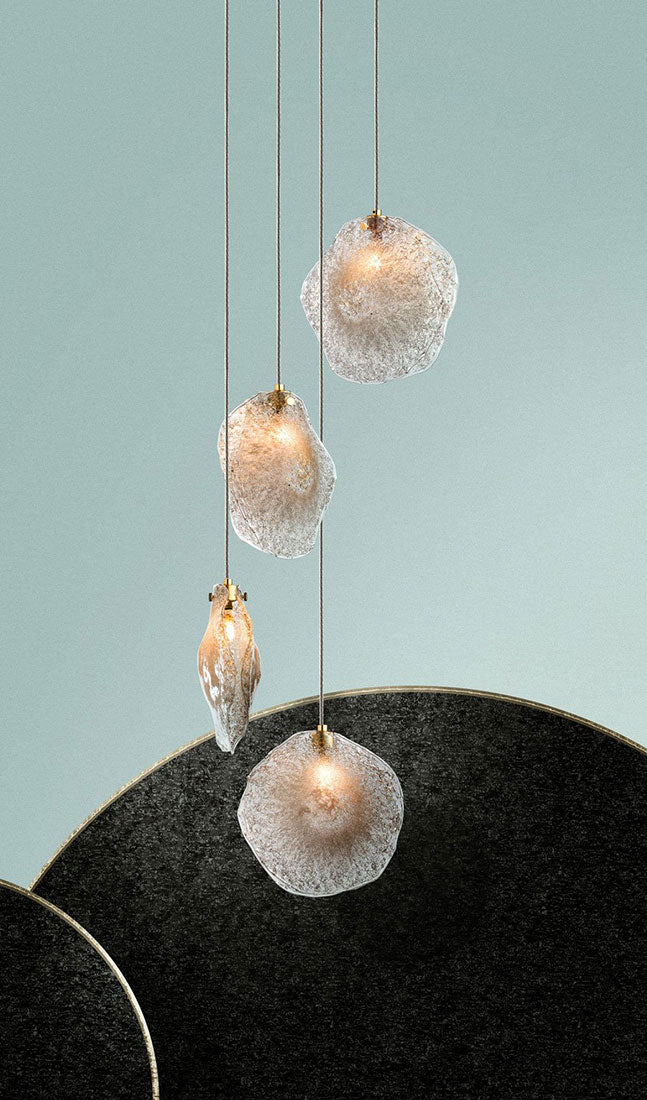


Most of the objects that surround us in modern homes are born on automated assembly lines. They are stamped, pressed, and packed by machines that repeat the same motions millions of times over. This mechanical efficiency gives us uniform products, but it strips away the soul of the object.
When you look at a piece of luxury lighting, you should see something entirely different. A premium light fixture should tell a story of heat, human skill, and raw elements transforming into art.
At Shakúff, we believe that light is best experienced through the organic variations of artisanal craftsmanship. The journey of our lighting pieces is defined by extreme environments and precise human touch. To truly appreciate the depth, texture, and character of a bespoke lighting installation, you have to understand the intense physical process that creates it: the 2000 degree journey of a hand-blown glass pendant.
From Raw Silica to Molten Fire
Every luxury pendant begins its life as a simple, unrefined mixture of raw materials. The foundation of high-end glass art is premium silica sand, combined with specific quantities of soda ash, lime, and custom metal oxides that later determine the final color and transparency of the piece.
These dry elements are placed inside a specialized ceramic crucible and subjected to an environment that mimics the depths of an active volcano. To liquefy solid sand, the furnace must reach an astonishingly high temperature.
At over 2000°F, the chemical structures bond together, turning the raw powder into a glowing, honey-like fluid. This intense heat must be maintained with absolute consistency; even a slight drop in temperature can alter the viscosity of the liquid, ruin batch clarity, or leave structural weaknesses in the glass.

At temperatures exceeding 2000°F, raw silica sand transforms into a brilliant, workable molten state.
The artisan stands before this open furnace, gathering the brilliant orange liquid onto the tip of a hollow stainless steel blowpipe. This initial gather is the true starting point of the 2000 degree journey of a hand-blown glass pendant.
Shaping Liquid Light
Once the molten glass is gathered on the blowpipe, the glassblower must move with a combination of speed and deliberate restraint. Liquid glass at this temperature reacts constantly to gravity. If the artisan stops rotating the blowpipe for even a few seconds, the molten mass will sag, lose its center, and fall to the floor.
To shape this volatile medium into a high-end light fixture, the studio relies on traditional hand tools and human breath:
- The Marver: A thick, polished steel or iron table where the glassblower rolls the molten glass to cool the outer skin and establish a balanced cylindrical shape.
- Wooden Blocks: Cherry wood scoops soaked thoroughly in water. When held against the 2000°F glass, a protective barrier of steam forms, allowing the artist to smoothly shape the piece into a perfect sphere or teardrop without scratching the surface.
- Artisanal Breath: The glassblower blows gently down the hollow pipe, introducing a small bubble of air into the core of the molten mass. This initial bubble expands slowly, creating the internal chamber that will eventually house the light source.
Throughout this process, the glass cools rapidly as it hits the room air. To keep the material workable, the artisan must repeatedly return the glass to a secondary furnace known as the "glory hole." This cycle of heating, shaping, and cooling defines the rhythm of the glass studio, requiring decades of muscle memory to master.
Introducing Character: Seeds and Textures
What separates mass-produced commercial glass from an elite, bespoke pendant is the intentional introduction of organic character. While automated factories use chemicals to force every tiny air pocket out of the material, studio artisans embrace the natural movement of the glass.
During the heating and blowing cycles, minute air pockets, known in the art world as "seeds", become permanently trapped within the cooling walls of the pendant. These seeds are not flaws; they are the literal thumbprint of the maker.
When you install a completed fixture, these internal structures act as microscopic lenses. They bend, scatter, and soften the light rays, projecting organic reflections across your walls that flat factory glass can never replicate.
Production Characteristics: Artisanal vs. Mechanical
To see the value of this process clearly, we can compare the physical properties of handcrafted art glass against standard industrial alternatives.
Glass Architecture Matrix
| Structural Parameter | Factory Assembly Line Glass | Hand-Blown Artisanal Glass |
|---|---|---|
| Melting Temperature | Regulated lower-tier melting lines | 2,000°F+ high-purity crucible kilns |
| Material Thickness | Uniformly thin, lightweight, fragile | Substantial, varying wall thickness with high density |
| Optical Properties | Direct light transmission, prone to harsh glare | Multi-directional refraction, warm ambient diffusion |
| Surface Finish | Completely smooth, sterile, machine-stamped | Textured, dimpled, or filled with unique internal seeds |
| Visual Value | Monotonous, repeated identically | Distinctly unique; no two pendants are ever identical |
The Critical Cooling Phase: Stress Relief in the Annealer
The physical shaping of the pendant is only half the battle. Once the desired geometry is achieved, whether it is a smooth sphere or a rippled shell, the glass must be cooled down under strict scientific conditions.
If a finished piece is left to cool on a table at room temperature, the outer layers of glass will contract much faster than the protected internal layers. This uneven cooling sets up immense internal mechanical stresses, causing the glass to spontaneously shatter into pieces.
To prevent this, the artisan detaches the completed pendant from the blowpipe and immediately transfers it into a specialized computer-controlled oven called an annealing lehr.
Over the course of 12 to 24 hours, the annealer slowly lowers the temperature from around 900°F down to room temperature. This gradual descent allows the structural molecules to stabilize evenly, neutralizing internal stress and giving the glass its legendary durability and structural strength.
Design Integration for Luxury Interiors
Once the glass has emerged safely from the annealing oven, it undergoes meticulous post-production trimming, polishing, and quality testing. From there, it is ready to be integrated into custom residential or commercial projects.

Bespoke pendants create a rich, tactile atmosphere when integrated into custom lighting layouts.
Because every single pendant undergoes this complex, hands-on production cycle, the lighting can be customized to match the scale and color palette of your specific environment.
The Power of Multi-Pendant Formations
While a single hand-blown pendant looks beautiful floating above a bedside table or highlighting an intimate reading corner, these fixtures reveal their true design power when arranged in large groups. Staggering multiple pendants at varying heights over a kitchen island, a dining table, or within a high-ceiling foyer creates a dynamic, layered architectural installation.
Collections like our Crystal Shell Chandelier Collection display this design beautifully. The wavy edges and dense internal textures of the glass play off one another, multiplying the light scattering effect throughout the room. Whether you are featuring a single statement piece like the Crystal Shell Single Pendant or an expansive multi-tiered layout, the presence of real, hand-crafted glass shifts the energy of a room completely.
Merging Fine Art with Structural Integrity
A luxury light fixture must be as structurally sound as it is visually beautiful. Hand-blown art glass is heavy, and hanging dozens of unique pieces requires a highly engineered suspension system.
At Shakúff, we couple our traditional glass artistry with heavy-duty metal canopies, high-tensile aircraft wires, and advanced electrical components. This ensures that your custom chandelier can be safely installed, adjusted, and enjoyed for generations.
Architectural Checklist: Because bespoke art glass carries significant weight, always coordinate with your general contractor and electrical team to ensure your ceiling boxes are reinforced to handle the specific load requirements of your new custom lighting installation.
Furthermore, we design our fixtures to operate with energy-efficient, high-CRI LED systems. These modern light sources produce minimal heat, preserving the vibrant color gradients and delicate textures of the glass while bathing your space in a warm, accurate glow.
Explore Our Handcrafted Collections

A completed multi-pendant installation acts as a living architectural sculpture.
If you are ready to bring the beauty of authentic glassblowing into your upcoming interior design project, explore our product resources and full design maps:
- Discover our design philosophy and view our full project gallery.
- Look through our full catalog of custom glass choices on our dedicated Collection.
For deep historical context on the science of glass art and the evolution of kiln engineering, explore the public archives at the Corning Museum of Glass. To review modern luxury lighting safety codes and photometric standards, consult the guidelines set by the Illuminating Engineering Society.
Frequently Asked Questions
Why does hand-blown glass cost more than factory lighting?
Hand-blown lighting requires a team of highly skilled artisans, massive energy to run specialized kilns at 2000°F, and hours of hands-on labor for every individual piece. You are purchasing a one-of-a-kind art piece rather than a stamped plastic or thin glass imitation.
Are the small bubbles in the pendant considered defects?
No. Tiny bubbles, or "seeds," are a celebrated characteristic of high-end, hand-blown glass. They show that the piece was shaped by human hands and serve to diffuse light in a warm, beautiful way.
How long does it take to make and ship a custom pendant fixture?
Because each component is crafted to order in our hot shops and thoroughly inspected through the annealing phase, our standard production lead time runs between 10 and 12 weeks.