


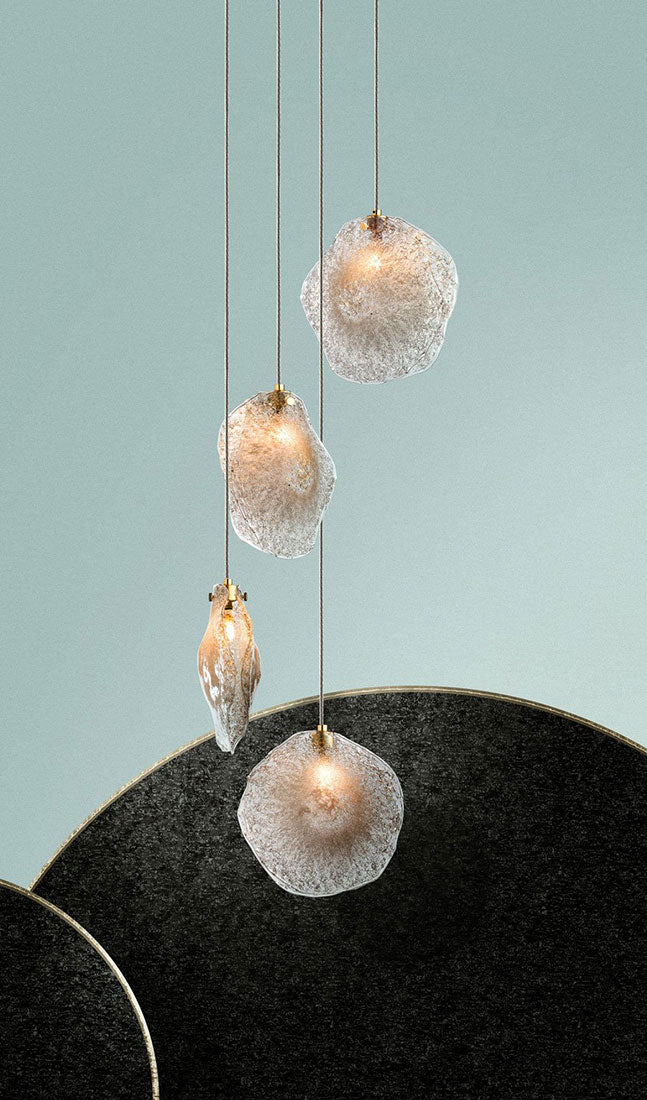


Hand-blown glass lighting is worth the investment when the goal is more than basic illumination. It combines functional lighting with craftsmanship, material depth, customization, and sculptural presence, making the fixture part of the interior architecture rather than simply an accessory.
For homeowners, designers, and architects, the value often comes from how these pieces are made and how precisely they can respond to a space. Shakúff’s collections use handcrafted blown glass across chandeliers, pendants, sconces, floor lamps, and table lamps, with many designs available in different sizes, colors, finishes, and configurations.
Hand-Blown Glass Has Material Character Mass Production Cannot Replicate
One of the clearest differences between handcrafted and mass-produced lighting is variation.
Hand-blown glass is shaped individually, so subtle differences in form, texture, color, and surface naturally appear from one piece to another. Shakúff specifically notes that variations in size, color, shape, and texture are inherent to its handcrafted glass.
Those differences matter because glass is highly responsive to light. Small changes in dimpling, thickness, curvature, or texture can affect reflections and shadows in ways that feel more organic than perfectly uniform factory-made components.
The Nimbus collection, for example, uses smooth blown-glass orbs that are carefully dimpled by hand. The resulting surface creates a sense of movement while keeping the overall form restrained.
The value is not simply that the fixture is handmade. It is that the making process remains visible in the finished object.
You Are Investing in Craftsmanship, Not Just a Fixture
Hand-blown lighting requires skilled manipulation of hot glass, where form develops through heat, timing, shaping, and controlled movement.
That process is fundamentally different from producing identical molded components at scale.
Shakúff’s own journal describes the creation of a hand-blown glass chandelier as a collaborative process involving glassmaking, fabrication, and design rather than a single manufacturing step.
This distinction becomes especially important with larger chandeliers. Every glass component still needs to work as an individual object, but the complete installation must also function as one composition.
When many handmade elements are grouped together, small variations can create visual rhythm rather than mechanical repetition.
Customization Makes the Investment More Relevant to the Space
A premium fixture is most valuable when it fits the room properly.
Standard lighting often requires compromise. The proportions may be slightly too small, the drop may not suit the ceiling height, or the finish may not relate naturally to the materials already present.
Handcrafted lighting offers greater freedom to address those conditions.
Shakúff’s Kadur Drizzle collection can be customized through pendant quantity, glass size, suspension method, and arrangement. Pendants can be installed at similar or staggered heights, while canopies are sized according to the number of pendants specified.
For a double-height foyer, that flexibility can help create a long vertical composition. Over a dining table, the same design language can be adapted into a more concentrated grouping.
This is a significant part of the investment value. The fixture is not simply purchased for the room. It can be designed to interact with the room.
Hand-Blown Glass Can Function as Art and Lighting
A well-designed glass fixture has value even when it is switched off.
Texture, transparency, proportion, color, and silhouette remain visible during daylight, allowing the piece to function almost like sculpture within the interior.
The Tamar collection demonstrates this clearly. Its layered blown-glass tubes use drizzled glass to create texture, while light refracts through multiple layers when the fixture is illuminated.
That dual role can make handcrafted lighting especially compelling in spaces where designers want fewer but more meaningful objects.
Instead of adding artwork, decorative accessories, and lighting as separate visual layers, one sculptural fixture can perform several roles at once.
A Quality Fixture Can Define an Entire Room
Lighting often becomes one of the first things people notice in a room.
In a foyer, a chandelier can establish the visual character of the home immediately. Above a dining table, it can anchor the furniture arrangement. In a staircase, a vertical composition can connect multiple floors.
Shakúff’s Kadur Drizzle chandeliers are a good example of how repeated glass elements can be scaled to suit different interiors. The number of pendants can be customized, allowing the installation to grow from a smaller composition into a substantial architectural feature.
That ability to define space is one reason the cost of handcrafted lighting should not be evaluated in the same way as a purely functional ceiling fixture.
You are paying for its effect on the entire interior.
Glass Offers Exceptional Visual Flexibility
Another advantage of hand-blown glass is that it can have substantial physical presence without appearing visually heavy.
Clear and lightly tinted glass preserves sightlines, which is particularly useful in rooms with large windows, artwork, stone walls, or open architectural layouts.
Textured glass can create more visual density while still allowing light to move through the fixture.
The Kadur Drizzle 1 pendant illustrates this balance. Its inner orb contains drizzled glass fibers, while a clear outer sphere preserves the overall openness of the form. The product can be used individually or expanded into multi-pendant compositions tailored to the project.
This allows glass lighting to work across minimalist, contemporary, and more layered interior styles.
Bespoke Lighting Can Age Better Than Trend-Driven Fixtures
The strongest long-term value in handcrafted lighting comes from design relevance rather than novelty.
Fixtures built around material quality, proportion, and architecture are less dependent on short-lived decorative trends. A carefully proportioned glass chandelier can remain appropriate even if surrounding furniture, fabrics, or wall colors change.
Collections such as Tamar Wand rely on comparatively simple geometric ideas, layered glass, and precise metal detailing rather than excessive ornament.
This does not mean any handcrafted fixture is automatically timeless. The selection still needs to suit the architecture.
But investing in strong materials and considered proportions often creates greater longevity than choosing lighting solely because it reflects a temporary trend.
Custom Glass Lighting Offers More Design Freedom
Perhaps the strongest argument for investing in hand-blown lighting is freedom.
Shakúff’s current catalog includes customizable glass lighting across chandelier, pendant, floor lamp, table lamp, and sconce formats. Its collection filters include glass options such as clear, gold, black, gray, amber, frost, milk, and white, alongside metal and stone options depending on the design.
That means the design process can consider not only the fixture itself, but also:
-
Room proportions
-
Ceiling height
-
Glass color
-
Fixture scale
-
Pendant quantity
-
Suspension arrangement
-
Metal finish
-
Relationship to furniture and architecture
For high-end residential or hospitality projects, those choices can be the difference between lighting that merely fits and lighting that feels designed for the space.
Explore Shakúff’s hand-blown glass lighting collections to find customizable chandeliers, pendants, sconces, and lamps designed around craftsmanship, material character, and architectural proportion.
Frequently Asked Questions
Is hand-blown glass lighting more expensive than standard lighting?
It generally involves more craftsmanship and customization than mass-produced fixtures, so the investment can be higher. The added value comes from artisan production, material variation, customization options, and the ability to create a fixture that responds more closely to the proportions and design of a particular interior.
What makes hand-blown glass lighting unique?
Each glass element is individually formed, which allows subtle differences in shape, texture, and surface character. Shakúff notes that variations are inherent to its handcrafted glass. Those differences can become especially visible when light passes through the material or when multiple pendants are arranged together.
Can hand-blown lighting be customized for a specific room?
Yes. Shakúff offers customization across many collections. Depending on the fixture, options can include glass size, color, pendant quantity, suspension height, canopy configuration, and finish. This allows the lighting to respond more accurately to ceiling height, furniture placement, and architectural scale.
Does handmade glass require every pendant to look identical?
No. Subtle variation is part of the character of handcrafted glass. In multi-pendant installations, repeated proportions and colors can maintain visual consistency while small differences between individual pieces create a more organic composition.
Is hand-blown glass lighting suitable for modern interiors?
Yes. Hand-blown glass can work particularly well in modern interiors because it introduces texture and craftsmanship without necessarily adding visual clutter. Clean forms such as Nimbus or more linear designs such as Tamar Wand can complement restrained architecture while adding depth through glass and light.