


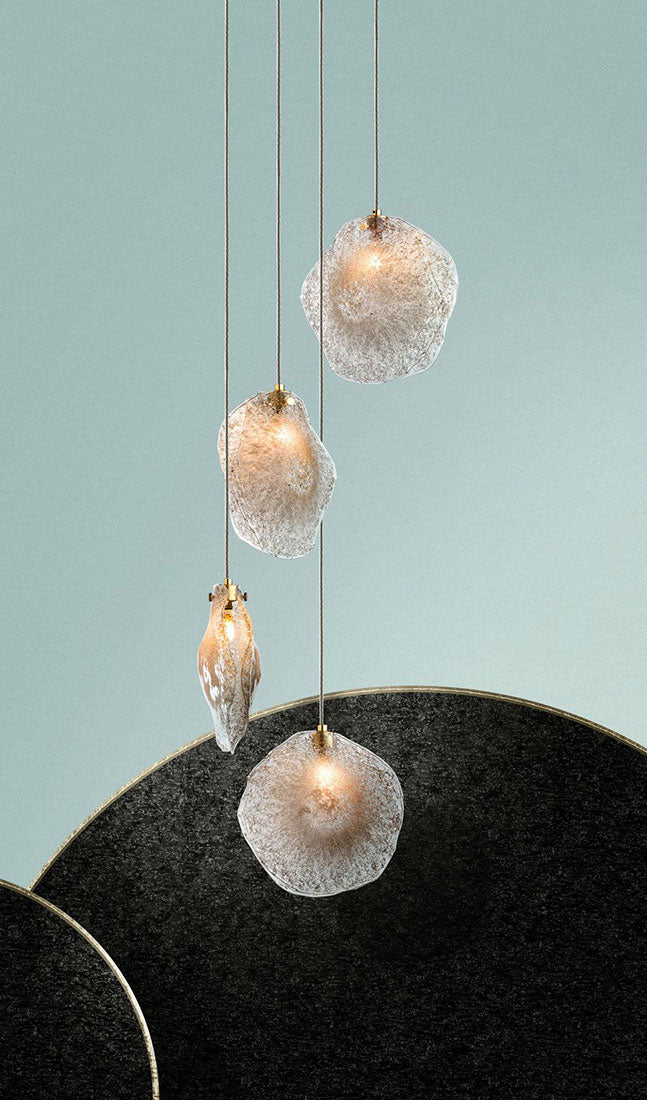


Most rooms are lit by objects you are meant to ignore. Sculptural lighting reverses that: the fixture is chosen, placed, and judged the way you would treat a piece of art. That changes almost every decision, from where it hangs to how the rest of the room supports it. This guide covers how designers approach a fixture as an artwork: reading it with the lights off, planning for different viewing distances, living alongside paintings, and treating the suspension as part of the composition.
Quick Answer
Sculptural lighting is a fixture designed to be read as an object in its own right, with a form and material that hold attention even when it is switched off. To make one work as art, treat it like a curated piece. Give it space and a clear viewing position, scale it to the room's volume, keep it out of the same sightline as major wall art, and layer other light sources so it does not carry the whole room. The tradeoff is commitment: a sculptural fixture sets the tone of the space, so the room has to be planned around it.
Key Takeaways
-
Judge it switched off. In daylight, a sculptural fixture is an object, not a light, and it has to hold its own that way.
-
Protect the negative space. A sculpture needs clear air around it, just as a gallery piece needs clear walls.
-
Design for every viewpoint. Plan how it reads from the doorway, the sofa, and from above on a stair or landing.
-
Let it lead, then layer. Keep the supporting light quieter so the piece remains the focal point without doing all the work.
-
Treat the hardware as part of the design. Canopy, drop, and suspension shape the composition as much as the glass does.
What Makes a Fixture Sculptural?
Any fixture can be decorative. A sculptural fixture is different because its form is the point. You notice its silhouette, its mass, its rhythm, and its material before you notice the light it gives off.
Hand-blown glass suits this role well. Every piece carries the record of how it was made: natural variations in size, color, shape and texture, along with bubbles, fissures, crackling and crazing. Those marks are what give a large composition the quality of a made object rather than a manufactured product.
The shift toward this kind of lighting is part of a wider move away from purely minimal fixtures, which we look at in our piece on why sculptural maximalism is replacing minimalist lighting. This article focuses on what happens once you have decided to commit to a sculptural piece.
Read It With the Lights Off
For most of the day, a fixture in a well-lit room is not switched on. That is when a sculptural piece proves itself. Clear glass picks up the color of the walls and the sky outside. Frosted glass holds a soft, even surface. Amber and gray glass read as solid color and give the composition weight.
Daylight also moves. Morning light from one side throws reflections and small highlights across the glass, while late afternoon light can make the whole piece glow. When you review a design, ask how it will look at noon, not only at night.
A useful test: if the fixture would look like an empty frame without power, it is a lamp. If it would still be the most interesting object in the room, it is sculpture.
Give the Piece Room to Breathe
Galleries give sculpture space so the eye can travel around it. A sculptural fixture needs the same thing. Crowding the ceiling with downlights, fans or a second statement piece dilutes the effect, and a busy coffered ceiling can make a complex composition read as clutter.
Negative space also helps the fixture relate to the architecture. Centering it on a table, a stair void, or a window wall gives it a reason to be where it is. Our guide to designing a room around a statement fixture goes deeper into how furniture and finishes can support a single focal point.
Design for Every Viewing Distance
Art is seen at different distances, and so is a sculptural fixture. Each distance asks something different of the design.
|
Viewing Position |
What the Eye Reads |
Design Implication |
|
Entrance or across the room |
Silhouette and overall mass |
A clear outline, scaled to the volume of the space |
|
Seated, mid-distance |
Rhythm, spacing and color mix |
Even density and an intentional color distribution |
|
Up close or passing by |
Glass texture, bubbles, joinery |
Glass quality and hardware details carry the experience |
|
From above, on a stair or landing |
The composition in plan |
The arrangement must work from overhead, not only in elevation |
The overhead view is the one most often forgotten. In a double-height entry or stairwell, people look down into the fixture as often as they look up at it. A cascade that looks dramatic in elevation can look disorganized from above if the plan has not been considered.
Living Alongside Paintings and Objects
A sculptural fixture and a major painting should rarely share the same frame of view. When both compete for the first glance, neither wins. Place the fixture where it owns its own sightline, or let it sit above and between, reading as a canopy over the room rather than a rival to the wall.
Glass has an advantage here. Clear and lightly tinted glass lets art and architecture show through it, so even a large fixture can feel open. Colored glass can pick up a tone from a painting or a rug and connect the two without matching them literally.
Watch for reflections. Framed works under glass and high-gloss finishes can mirror a bright fixture at night. Dimming the fixture and adding accent lighting on the art usually resolves this. Many collectors now treat lighting as part of their collection, a shift we explore in why homeowners are putting their art budget on the ceiling.
When the Fixture Leaves the Ceiling
The most sculptural pieces often refuse to stay in one plane. In a Brooklyn home office with low ceilings, the client asked for an interactive art installation. Shakúff's answer was a bespoke Ivy Branch in brushed brass that spans the ceiling, crosses a beam and runs down the wall, with amber Kadur Drizzle pendants giving warm light. The low ceiling became a reason for the piece to travel rather than a limitation.
At a larger scale, The Continental Hall in Williamsburg combines 480 Dew pendants on four monopoint grippers with eight Ivy Branch sconces, built from 120 more pendants, flanking the doors. The ceiling fixture and the wall pieces read as one composition that frames the entire room.
Commissioning a Piece Instead of Choosing One
If you are looking at a room and thinking about what the light should say rather than which product will fit, the conversation is a commission. Shakúff develops sculptural compositions from the room's dimensions, sightlines, and materials, and shows them in drawings before anything is made.
The Hardware Is Part of the Composition
In a sculptural fixture, nothing is neutral. The canopy, the suspension and the drop all shape how the piece reads. A canopy that is too small looks like an afterthought; one that is too large flattens the composition against the ceiling.
|
Suspension Approach |
Visual Effect |
Works Well When |
|
Single shaped canopy |
A defined footprint with a concentrated mass |
The fixture centers on a table, island or void |
|
Monopoint grippers |
Pendants appear to float, each at its own height |
A free cascade or an irregular ceiling |
|
Branch structures |
Metal becomes a line drawing across the room |
The piece should extend along a ceiling or wall |
Finish matters as much as form. A matte white canopy can disappear into a white ceiling so the glass seems to hang on its own, while brushed brass turns the structure into part of the artwork.
Layer the Rest of the Light
A sculptural piece should rarely be the only light in the room. If it has to provide all the task lighting, it gets turned up too bright and loses its subtlety. Let recessed, wall and lamp light do the practical work, and let the fixture set the mood.
Shakúff fixtures use LED lighting and are dimmable, which lets a piece move from a glowing focal point in the evening to a quieter object during the day. Separate switching can add another layer. At the Skillman Residence in Delray Beach, a custom canopy with integrated LED lighting is switched separately from the Twist pendants below it.
How a Sculptural Commission Comes Together
Shakúff's custom work starts with the space, the design direction and the budget. Inspiration images are welcome, though they are used as a starting point rather than something to copy. The studio then recommends canopy size and shape, pendant count and finishes, and presents customized drawings with a quote. Drawings are free.
Once approved, fixtures are designed, engineered and assembled in Shakúff's Industry City studio in Brooklyn, using glass hand-blown by artisans selected by founder Joseph Sidof. Custom work typically takes 10 to 14 weeks. Shakúff does not install, so each piece ships with detailed instructions, and the studio works with your contractor and electrician. You can see the range of past commissions in the Shakúff gallery.
Frequently Asked Questions
Is sculptural lighting only for large rooms?
No. Scale should follow the room, not the other way around. A low-ceilinged room can carry a sculptural piece if it travels horizontally, wraps a beam or extends down a wall, as the Brooklyn home office project shows. What matters is giving the piece clear space and a defined viewing position rather than sheer size.
Can a sculptural fixture still provide useful light?
Yes, but it works best as part of a layered scheme. Shakúff fixtures are LED and dimmable, so they can provide real ambient light. Pairing them with quieter task and accent lighting keeps the fixture at a comfortable brightness and preserves its character as an object.
Will the finished fixture look exactly like the drawing?
The composition, scale, canopy, and arrangement will follow the approved drawings. The individual glass pieces will not be identical, because hand-blown glass naturally varies in size, color, shape, and texture. Those variations are part of what makes the piece read as sculpture rather than a mass-produced product.
Can I see the glass before committing to a design?
Yes. Most designs are on display at Shakúff's showroom in Industry City, Brooklyn, which is also open on Sundays by appointment. You can also see pieces through partner showrooms across the US or order samples, which are usually charged, with the cost reversed when they are returned in good condition.
Does Shakúff install sculptural fixtures?
No. Shakúff designs, engineers, and assembles the fixture, then ships it with detailed installation instructions. Installation is carried out by your own contractor and electrician, and the studio works directly with them so the process runs smoothly, which matters most for large or multi-point compositions.
Bring the Room an Original
A sculptural fixture is the rare piece of art that also shapes the light around it. If you have a room that deserves one, Shakúff can develop a hand-blown glass composition around its proportions, sightlines and materials, from a single branch across a ceiling to an installation that frames a whole space.
Explore Shakúff custom projects or tell the studio about your room.