


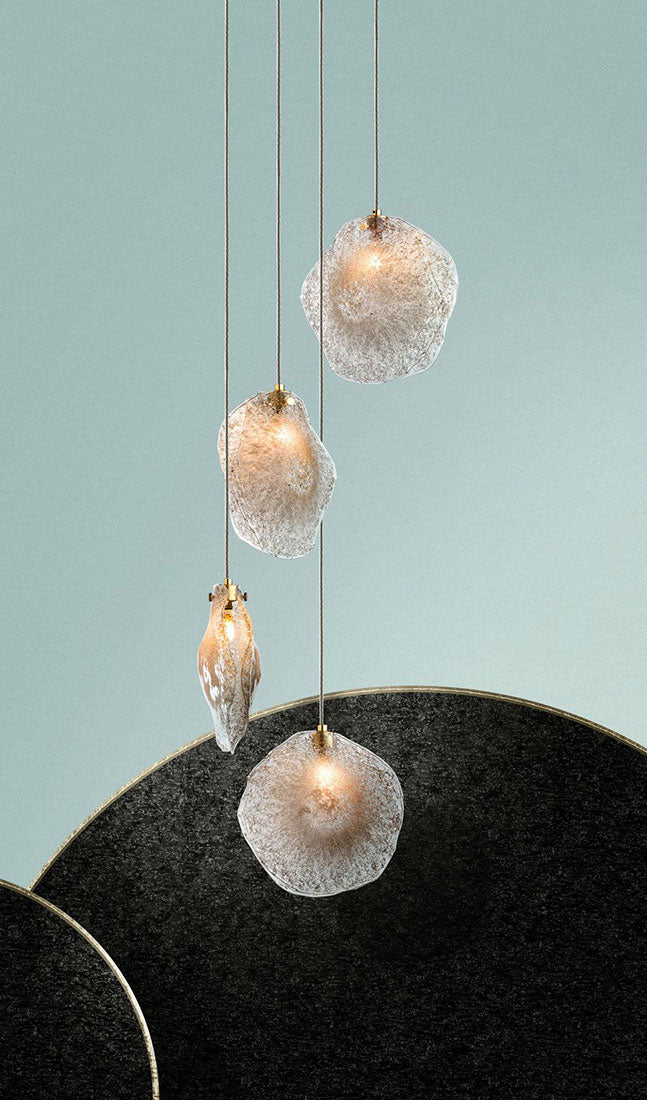


In a Los Angeles house built for indoor-outdoor living, the walls slide away, and the living room becomes part of the garden. That changes what a light fixture has to do. You see it from the terrace as often as from the sofa; it sits in daylight most of the day, and at night it reflects in walls of glass. This guide explains how to place and choose sculptural fixtures for open-plan LA homes: where they belong along the line between inside and out, how different architectural styles shape the choice, how to manage reflections, and where hand-blown glass should and should not go.
Quick Answer
For LA's indoor-outdoor homes, place sculptural fixtures inside the conditioned envelope, close enough to the opening walls that they read from the terrace and garden. Choose forms with a strong silhouette and organic movement that echo the landscape, and glass that holds its own in bright daylight. Plan for night-time reflections in large glass walls through placement and dimming. Hand-blown glass fixtures belong indoors; for covered patios or weather-exposed spaces, use exterior-rated lighting and confirm suitability with the maker first.
Key Takeaways
-
The threshold is the stage. Fixtures placed just inside the glass line are seen from both the room and the garden.
-
Silhouette matters more than sparkle. From outside, people read the overall form before the detail.
-
Reflections are part of the design. Glass walls mirror fixtures at night, so plan placement and dimming from the start.
-
Architecture sets the vocabulary. Mid-century, contemporary, and Spanish revival homes each suit a different kind of composition.
-
Keep hand-blown glass indoors. Use exterior-rated fixtures on patios and in spaces open to the weather.

When the Wall Disappears, the Fixture Faces Two Ways
In a conventional room, a fixture has an obvious front: it faces the people inside. In an LA great room with a pocketing glass wall, no single front exists. Guests on the terrace look back into the house, and the fixture becomes the focal point of the view from the garden.
That makes the fixture part of the architecture of the threshold. Placed well, it marks the edge between inside and out and draws people across it. Placed carelessly, it hangs in the middle of the room and disappears behind reflections. Thinking about lighting as part of the building, rather than as furniture, is the core idea in our article on how custom lighting transforms architectural spaces.
Mapping the Zones From House to Garden
Indoor-outdoor homes work best when you plan lighting as a sequence of zones, each with a different job.
|
Zone |
Role of the Light |
Lighting Direction |
|
Interior core (kitchen, dining, stair) |
Anchor the house and its daily routines |
Sculptural statement pieces sized to the room |
|
Threshold room with opening walls |
Visible focal point from inside and out |
Strong silhouette placed inside the glass line |
|
Covered terrace or loggia |
Extend evenings outdoors |
Exterior-rated fixtures; confirm before using decorative glass |
|
Garden and landscape |
Depth and safety after dark |
Low-level landscape lighting that frames the view back to the house |
The sculptural fixture lives in the first two zones. Landscape lighting in the garden then gives it a backdrop, so the view from inside does not end at a black window.
Silhouette First: Designing to Be Seen From the Terrace
From thirty feet away on a terrace, nobody sees bubbles in the glass. They see a shape against the ceiling. A sculptural fixture for an indoor-outdoor room needs a clear, confident outline: a cloud, a cascade, a branch, or a defined cluster that reads at a distance.
Organic forms suit this setting especially well, because they echo the trees, foliage, and hills beyond the glass. Our article on biophilic lighting and nature-inspired glass explores this connection, and our piece on how the Ivy Branch and Aleh Wave bring movement to a room shows how branch forms carry the garden indoors.
Design Around the Glass Wall at Night
After dark, a closed glass wall becomes a mirror. A bright fixture appears twice, and its reflection can sit right in the middle of the view you designed the room around. When the walls are open, the problem disappears; when they are closed, it is the first thing you see.
Plan for both states. Offset the fixture from the main view line so its reflection lands to one side. Use dimming, since Shakúff fixtures are LED and dimmable, to lower brightness after sunset. Frosted and tinted glass produce softer reflections than clear glass, and garden lighting outside reduces the mirror effect by balancing brightness on both sides of the glass. Our guide to lighting a staircase without reflection glare covers the same principles in a vertical space.
Planning a Fixture Around the View
If your project has a great room that opens to the garden, the fixture should be drawn with the glass walls, sightlines and ceiling in mind. Shakúff develops custom compositions from plans, elevations, and photographs, and presents them in customized drawings with a quote before anything is made.
Matching the Fixture to LA Architecture
Los Angeles has several distinct indoor-outdoor traditions, and each suggests a different lighting approach.
|
Architectural Style |
Typical Conditions |
Fixture Direction |
|
Mid-century post-and-beam |
Low horizontal ceilings, exposed beams, clerestory windows |
Horizontal or branch compositions; canopies planned around beams |
|
Contemporary glass pavilion |
Tall volumes, minimal detail, full-height glazing |
Vertical cascades and clouds with a strong silhouette |
|
Spanish revival with courtyard |
Plaster walls, timber ceilings, arches, enclosed outdoor rooms |
Warm amber and organic forms that suit plaster and wood |
In beamed ceilings, the mounting point is often the hardest part. We can design custom canopies and suspension around timber rather than forcing a fixture into a gap. Hardware also needs to suit the architecture, which our guide to lighting hardware for modern architecture covers in detail.
Glass in California Light
LA daylight is bright and clear, flooding an indoor-outdoor room. Hand-blown glass responds to that light all day. Clear glass catches reflections of sky and greenery, frosted glass glows softly even unlit, and amber, gray, and black read as solid tones against pale walls.
Because each piece is hand-blown, the glass varies naturally in size, color, shape, and texture, including bubbles, fissures, crackling, and crazing. In strong daylight, those variations are visible up close, which rewards people who walk in from the terrace and look up.
Warm and cool tones can also connect the fixture to the surrounding materials. At the Truckee Residence in California, a 60-pendant chandelier in amber, gray, and black Drizzle glass runs through a three-floor stairway, with tones chosen to answer the warm wood ceiling and the cool grays of the steps and structure.
Shakúff in Los Angeles
Shakúff's Los Angeles work includes Q Sushi, where gold Kadur Drizzle pendants are arranged in a slight wave over the sushi bar, lighting the chefs and the food. Shakúff designs, engineers, and assembles fixtures for LA in its Industry City studio in Brooklyn, using glass hand-blown by artisans selected by founder Joseph Sidof, and ships them crated to the site.
Shakúff does not install. Each fixture ships with detailed installation instructions, and the studio works directly with your contractor and electrician. You can see the full list of places Shakúff has delivered projects on its service areas page.
How an LA Project Comes Together
Projects away from New York are designed on drawings. Share the ceiling height, span, elevations, and photos of the room and its views, and Shakúff returns recommendations for canopy size and shape, pendant count, and finishes, along with custom drawings and a quote. Drawings are free. Custom work typically takes 10 to 14 weeks after fabrication begins.
Collections such as Nimbus offer organic, cloud-like forms that suit indoor-outdoor rooms, and many collections can be customized in color, finish, and size depending on the collection. You can review the full steps on Shakúff's custom process page.
A Fixture Worth Seeing From the Garden
In an indoor-outdoor home, the best fixture is the one that holds the room together whether the walls are open or closed. Shakúff designs custom hand-blown glass compositions around your architecture, your views, and the way light moves through the house, from Brooklyn to the West Coast.
Start your Los Angeles lighting project
Frequently Asked Questions
Can I hang a hand-blown glass fixture on a covered patio?
Treat that as a question for the studio, not an assumption. Shakúff's published specifications do not list outdoor, damp, or wet ratings. Place hand-blown fixtures inside the conditioned interior, and use exterior-rated lighting for patios, loggias, and other spaces exposed to weather unless the studio confirms otherwise.
Where should a statement fixture go in a room with opening glass walls?
Usually inside the glass line and slightly off the main view axis. That keeps it visible from the terrace when the walls are open, while moving its night-time reflection away from the center of the view when they are closed. Align it with the dining table, island, or seating group it serves.
How do I stop a fixture reflecting in my windows at night?
You can reduce reflections rather than eliminate them. Offset the fixture from the main view, dim it after dark, consider frosted or tinted glass, and add landscape lighting outside so the brightness on both sides of the glass is closer. Shakúff fixtures are LED and dimmable, which makes this easier.
Does Shakúff work on projects in Los Angeles?
Yes. Los Angeles is among the places Shakúff has delivered projects, including Q Sushi. Fixtures are designed from your drawings, made in Brooklyn, and shipped crated with installation instructions. Your own contractor and electrician handle installation, with the studio coordinating directly with them.
Can I see Shakúff fixtures before ordering from California?
Yes. You can see pieces through Shakúff's partner showrooms across the US, order samples, which are usually charged, with the cost reversed when returned in good condition, or visit the showroom in Industry City, Brooklyn, where most designs are on display.